
EXPLORE JEBUS
Before Jerusalem, there was Jebus.
BEFORE JERUSALEM
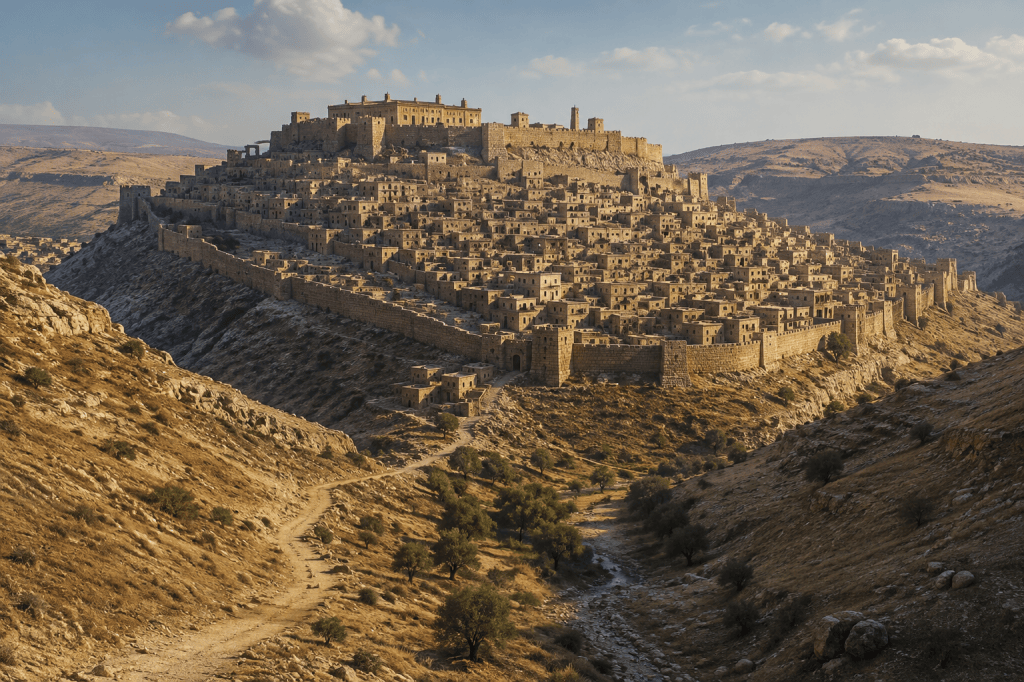
Long before Jerusalem became the sacred capital of Israel, a fortified city already stood upon the narrow ridge between the Kidron and Tyropoeon valleys. The Bible calls it Jebus and identifies its inhabitants as the Jebusites, one of the peoples of ancient Canaan.
Its location was formidable. Steep valleys protected much of the settlement naturally, while walls and fortifications guarded the approaches to the city. A vital water source—the Gihon Spring—lay along the eastern slope, making control of water essential to the survival of the people behind those walls.
By the time of David, Jebus had endured for generations in the heart of the land claimed by Israel. Its continued independence was remarkable. The city that would one day become Jerusalem was, for the moment, still Jebus—and its walls had not yet fallen.
A CITY BETWEEN KINGDOMS
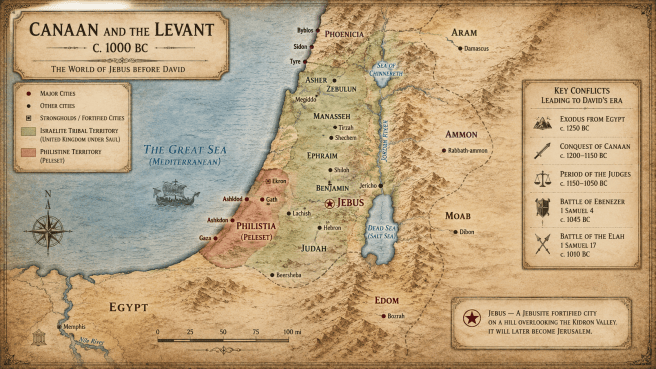
Jebus occupied a precarious position in the hill country of Canaan. Israelite territory surrounded much of the region, while the powerful Philistine cities dominated the coastal plain to the west. Yet the Jebusites continued to hold their fortified city, preserving an independent stronghold in the midst of a changing political landscape.
The biblical account itself suggests just how difficult the city was to dislodge. Generations before David, the tribe of Benjamin had failed to drive the Jebusites from Jerusalem, and they continued to live there alongside the Israelites. By David’s time, possession of the stronghold remained unfinished business.
For a rising kingdom seeking unity and control of the central hill country, Jebus represented more than another fortified settlement. Its position—and its independence—made the city increasingly difficult to ignore.
INSIDE THE WALLS OF JEBUS
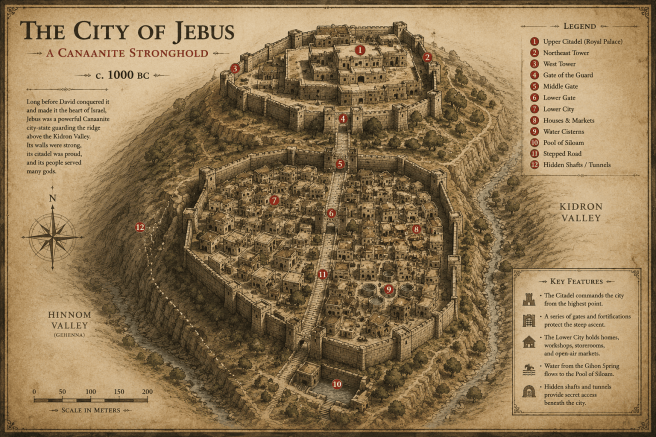
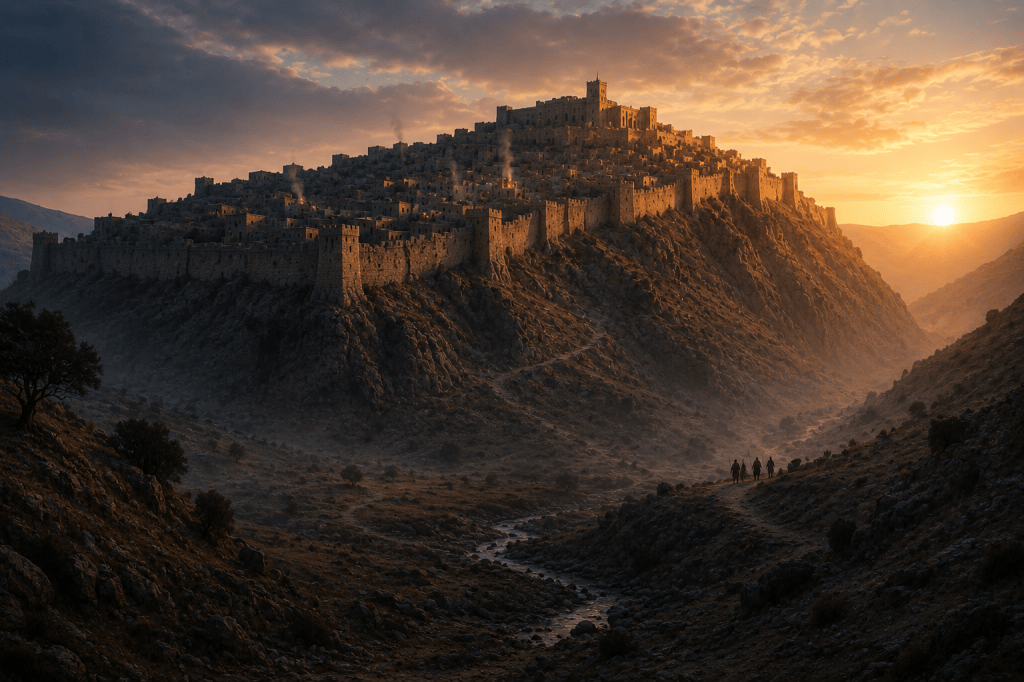
Jebus was not the sprawling Jerusalem familiar to later history. The ancient settlement occupied a much smaller and narrower ridge, its buildings crowded together within fortifications shaped as much by the steep terrain as by human hands. Space was precious, and the city climbed upward toward its strongest and most defensible ground.
At the upper end of the settlement stood the stronghold—the fortified heart of the city and the place from which its rulers could command the approaches below. Narrow streets and stepped pathways wound between stone and mud-brick structures, while defensive walls exploited the precipitous slopes surrounding the ridge.
Water was among the city’s most valuable resources. The Gihon Spring emerged along the eastern slope above the Kidron Valley, and ancient inhabitants developed increasingly sophisticated ways of protecting and accessing it. In a land where survival could depend upon the rains, securing water was as important as securing the walls themselves.
BENEATH THE CITY
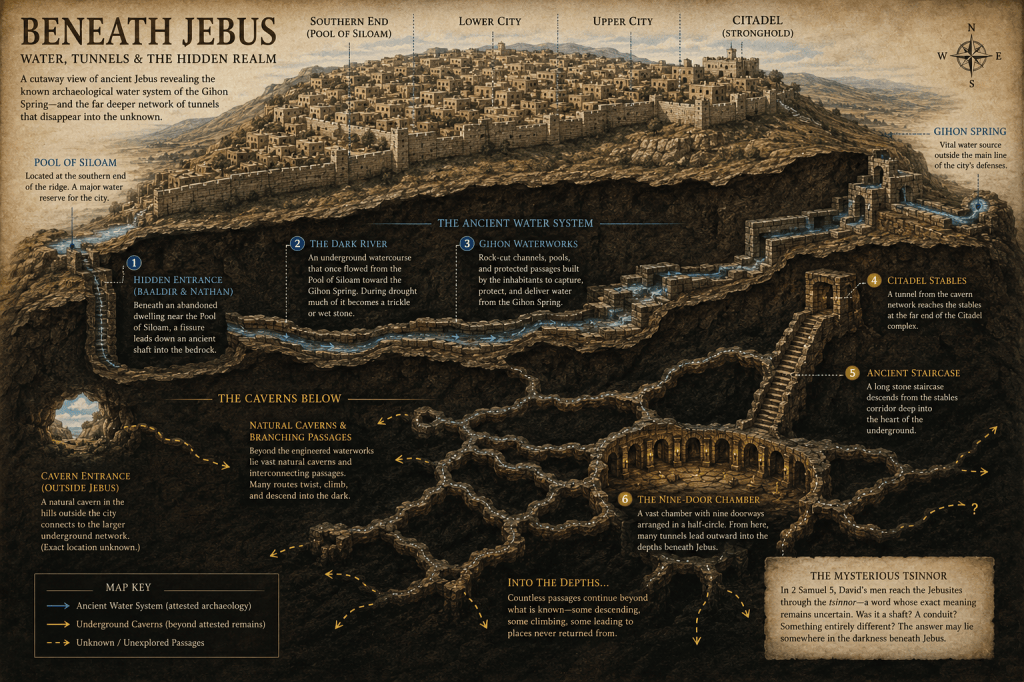
For the people of ancient Jebus, the greatest vulnerability of their hilltop stronghold may also have been its most precious resource. The Gihon Spring lay outside the main line of the settlement’s defenses, emerging from the eastern slope above the Kidron Valley. Protecting access to that water was essential—especially during siege.
Over centuries, the inhabitants of the ridge cut passages, shafts, channels, and tunnels through the limestone surrounding the spring. Archaeologists have uncovered an extraordinary complex of ancient waterworks beneath the City of David, although exactly when individual elements were constructed—and how they were used during the Jebusite period—remains debated.
That uncertainty becomes especially intriguing when the biblical account describes David’s capture of the city. In 2 Samuel 5, David challenges his men to reach the Jebusites through something the Hebrew text calls the tsinnor—a word whose precise meaning remains uncertain. It has often been associated with a water shaft or conduit, though scholars continue to debate what the passage actually describes.
What lay beneath Jebus may have been as important as the walls above it.
WHO WERE THE JEBUSITES?
The Jebusites are among the more enigmatic peoples named in the Hebrew Bible. They are described as inhabitants of the central hill country of Canaan and, most famously, as the people who held Jerusalem before its capture by David. Beyond those biblical references, however, identifying a distinct “Jebusite” culture in the archaeological record is difficult.
The city itself was ancient long before David. Archaeological evidence shows that the Jerusalem ridge had been occupied centuries before the Israelite monarchy, with substantial settlement reaching back into the Bronze Age. Its inhabitants belonged to the wider cultural world of Canaan, a region of fortified cities, local rulers, shifting alliances, and competing powers. But archaeology has not given us a clear archive, inscription, or material culture that allows us to reconstruct the Jebusites as neatly as we might reconstruct some neighboring peoples.
That leaves Jebus suspended between history and mystery. We know that an ancient city stood here. We know the biblical writers remembered a people called the Jebusites as its inhabitants. But much about who they were, how they governed themselves, what traditions they followed, and how they understood their own identity has been lost.
FROM SALEM TO JEBUS
Before it was Jebus, the ancient city was already part of a much older story
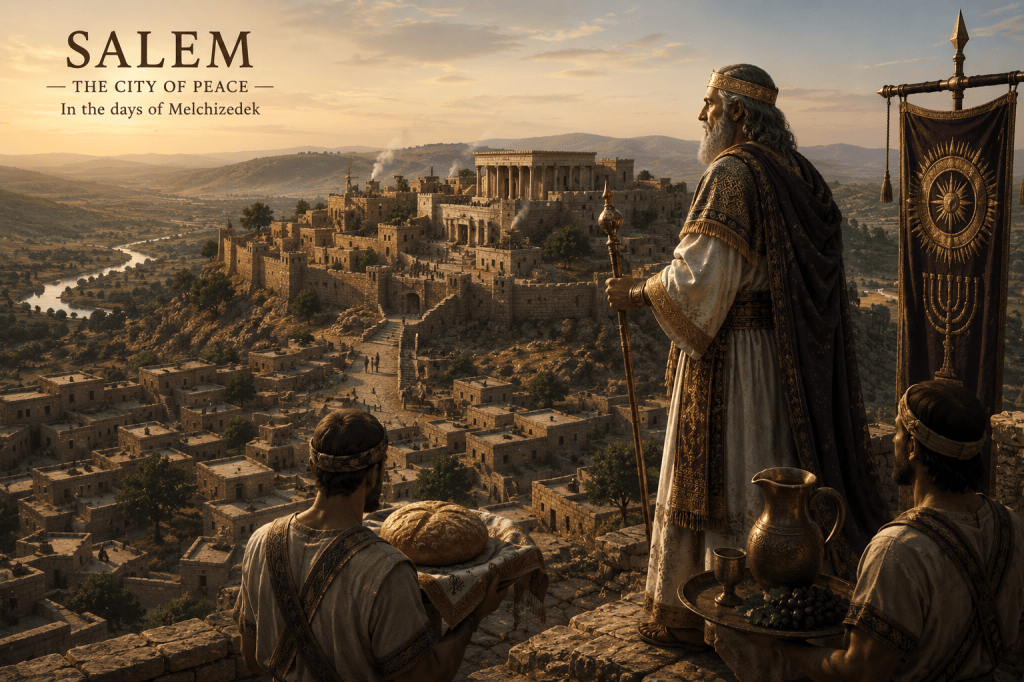
Long before the city was called Jebus, the biblical story introduces a mysterious ruler associated with Salem. In Genesis 14, Melchizedek—king of Salem and priest of God Most High—meets Abram after his victory over the eastern kings. He brings bread and wine, blesses Abram, and receives a tenth of what Abram has recovered. Then, almost as suddenly as he appears, Melchizedek disappears from the Genesis narrative.
His name is as intriguing as the man himself. The biblical book of Hebrews interprets Melchizedek as “king of righteousness” and connects Salem with peace. Centuries later, another ruler appears bearing a strikingly similar name: Adoni-zedek, king of Jerusalem, who forms a coalition of five Amorite kings against Joshua and the Israelites. Whether the shared element zedek simply expresses righteousness or reflects something deeper in the religious traditions of ancient Jerusalem remains debated.
The connection is tantalizing. Two rulers associated with the same ancient city, separated by generations, bear names formed around zedek. One is remembered as Melchizedek—the King of Righteousness. The other as Adoni-zedek—a name commonly understood along the lines of Lord of Righteousness or My Lord Is Righteous. History does not tell us whether this similarity represents coincidence, religious tradition, a divine name, or some form of royal convention.
IN AWAKEN THE DARK
The world of Awaken The Dark takes one possible answer to that ancient mystery and turns it into legend. In the novel, Adonizedek is not simply the personal name of a single ruler. It is an ancient royal title borne by the kings of Jebus—a title meaning “Lord of Righteousness,” deliberately echoing the mysterious Melchizedek, the “King of Righteousness,” who ruled Salem generations before.
The Adonizedek who rules Jebus in Awaken The Dark is therefore not intended to be the same Adoni-zedek who fought Joshua centuries earlier. He is the latest ruler to bear an ancient title—one that has survived through generations even as Salem became Jebus and the world surrounding the city changed.
Where the historical record falls silent, the story begins.
LIFE INSIDE JEBUS
The people who lived within Jebus belonged to the broader world of ancient Canaan. Their daily lives would have revolved around family, agriculture, trade, craftsmanship, religion, and the constant demands of survival. Homes were built closely together along the narrow ridge, with courtyards, work areas, storage vessels, grinding stones, ovens, and other necessities of household life occupying precious space within the fortified settlement.
Beyond the walls, farmers and herders depended upon the surrounding hills for grain, olives, grapes, sheep, and goats. Merchants and travelers connected the hill country with communities throughout Canaan and beyond, carrying goods, news, and ideas between settlements. Inside the city, craftsmen worked with pottery, textiles, leather, wood, stone, and metal while markets brought together the products of the surrounding countryside.
But life in the ancient hill country was always dependent upon water. Rainfall determined the success of crops, the health of livestock, and ultimately the survival of entire communities. Springs and cisterns could sustain a city through dry months, but prolonged drought could transform scarcity into crisis. For a fortified city such as Jebus, control of the Gihon Spring was therefore not merely a convenience. It was a matter of survival.
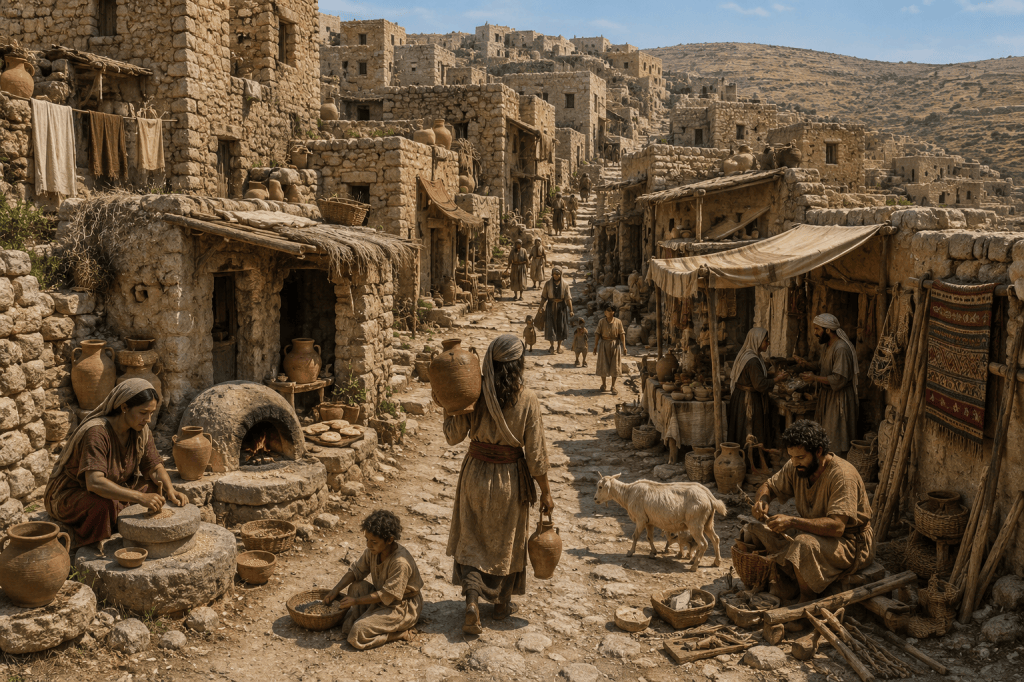
For the people of Jebus, daily life and the divine were never completely separate
A WORLD FILLED WITH GODS
The people of ancient Canaan lived in a world populated by divine powers. Across the region, communities worshipped gods associated with creation, storms, fertility, warfare, the sea, death, and the forces of nature upon which human survival depended. Among the names preserved from the wider Canaanite world are El, Baal, Asherah, Astarte, and others whose stories reveal a complex religious tradition stretching back centuries.
Exactly which deities were worshipped within Jebus during the age of David is much harder to establish. The city has left us no surviving Jebusite temple archive or collection of religious texts comparable to those discovered at places such as Ugarit. What we know therefore comes from archaeology, biblical traditions, and comparison with the wider religious culture of Canaan—and those sources do not always provide the same picture.
What is clearer is that the boundary between the natural and supernatural would not have been understood as it often is today. Gods could determine the rain. Divine favor could decide a battle. Dreams might carry warnings. Priests interpreted sacred rituals, offerings were made, and blessings and curses could possess very real power in the minds of those who received them. The unseen world was not separate from everyday life. It was woven through it.
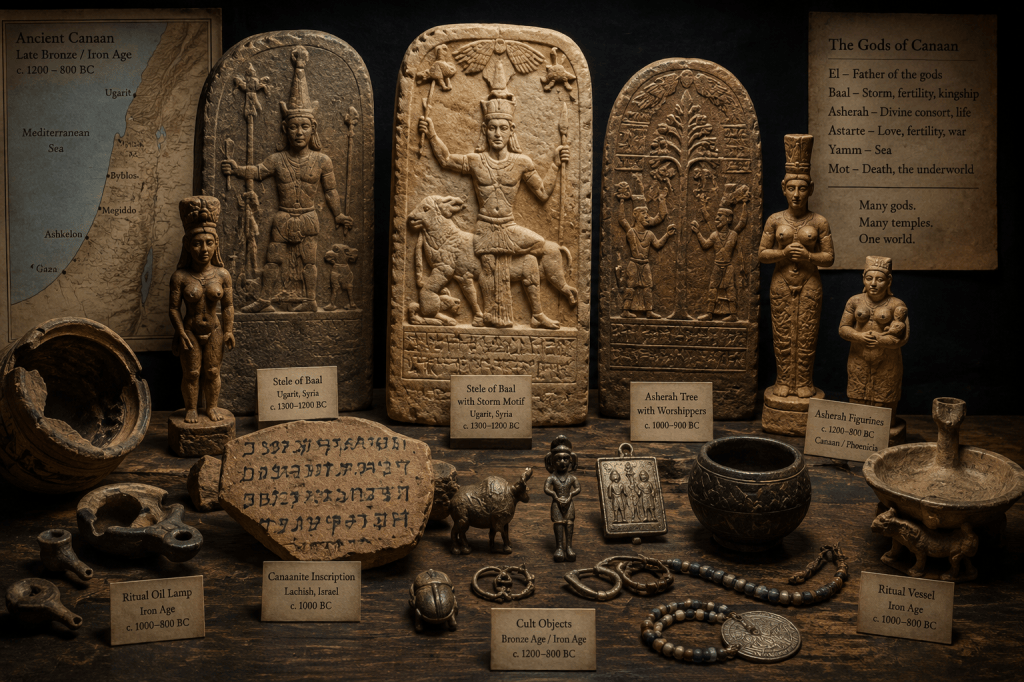
But the names preserved by history may not tell the whole story
BEYOND THE GODS OF CANAAN
The names by which ancient peoples understood the divine were shaped by culture, language, and time. A storm god in one land might bear little resemblance to a divine power described centuries later by another people—even when both traditions attempted to explain forces that existed beyond ordinary human understanding.
One of the stranger figures to emerge much later in the religious traditions of the ancient world is Yaldabaoth, a being found in several Gnostic texts from the early centuries of the Common Era. Often portrayed as an arrogant creator or ruler of the material world, Yaldabaoth belongs historically to a period more than a thousand years after the age in which Awaken The Dark is set. There is no historical evidence that the people of Jebus knew that name or worshipped a being called Yaldabaoth.
But Awaken The Dark asks a different question: what if the being existed long before humanity possessed the name by which later generations would remember him?
Within the mythology of Awaken The Dark, humanity has never possessed a complete understanding of the supernatural world. People encounter fragments of something far older than themselves and interpret what they witness through the languages, beliefs, and traditions available to them. Over centuries, the same ancient reality may leave very different echoes in different cultures.
A being remembered as a god by one people might be understood as an angel, demon, spirit, giant, or something else entirely by another. Names change. Stories change. Even the nature of the beings themselves becomes obscured as generations attempt to explain what their ancestors encountered. What survives is not necessarily the truth—but a human memory of it.
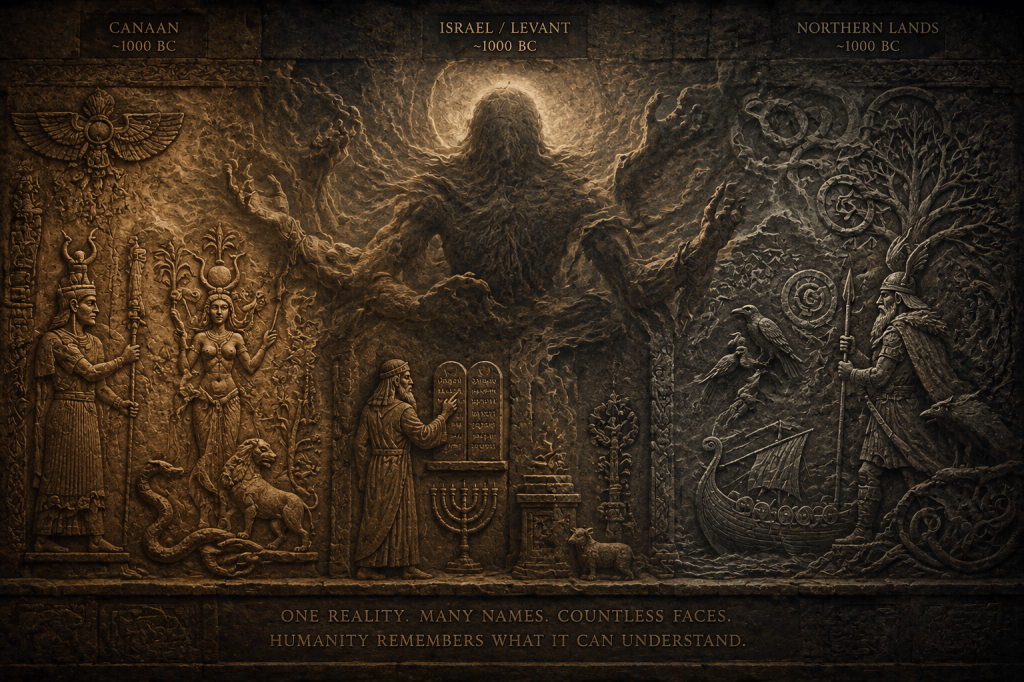
In Awaken The Dark, those echoes are not always accidental. Ancient stories may preserve fragments of encounters whose true nature has been forgotten, distorted, or given new names as they passed from one civilization to another. Some beings are remembered clearly. Others have become gods, monsters, angels, demons—or little more than whispers buried beneath later traditions. The oldest myths may not be stories. They may be memories.
But while legends endured, history was still moving toward Jebus
THE CITY DAVID COULD NOT IGNORE
By the time David emerged as king, Jebus occupied a position of unusual importance. The city stood in the central hill country near the boundary between Judah in the south and the territories of the northern tribes. For a ruler attempting to unite those groups beneath a single crown, controlling the ancient stronghold offered both a strategic and political advantage.
Hebron had served as David’s first capital, but it lay deep within Judah—David’s own tribal homeland. Jebus offered something different. Because the city remained outside Israelite control, its capture could provide David with a royal center that did not already belong to one of Israel’s major tribes. Jerusalem could become David’s city rather than simply the inherited possession of Judah, Benjamin, or another tribal power.
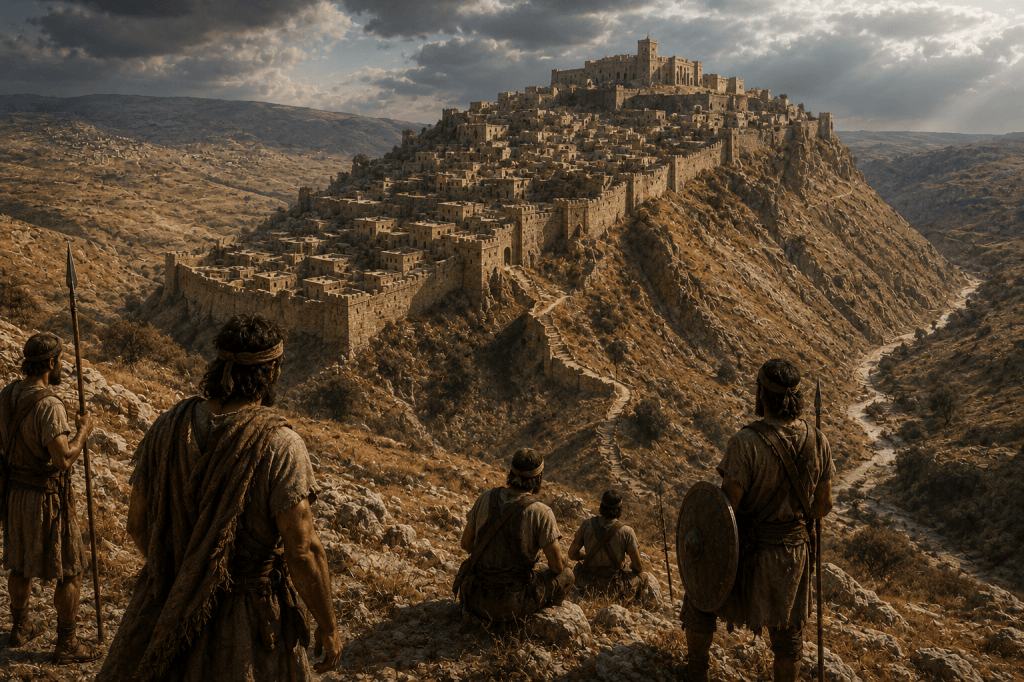
But first he had to take it. The biblical account portrays the inhabitants as extraordinarily confident in their defenses, taunting David that even “the blind and the lame” could keep him out. Yet 2 Samuel records that David captured the stronghold of Zion, after which it became known as the City of David. Exactly how his forces penetrated those defenses is where the story becomes considerably more mysterious.
THE MYSTERY OF THE TSINNOR
The biblical account of David’s capture of Jebus contains one tantalizing clue. In 2 Samuel 5:8, David challenges his men to reach the Jebusites through something called the tsinnor. The Hebrew word is unusual, and its precise meaning remains uncertain. Depending upon the translation and interpretation, it has been rendered as a water shaft, watercourse, conduit, or something similar.
The discovery of ancient waterworks beneath Jerusalem once seemed to offer a dramatic solution. Warren’s Shaft—a natural vertical opening within the underground system near the Gihon Spring—was proposed as the route by which David’s men secretly entered the city. It was an irresistible image: warriors climbing through the darkness beneath Jebus before emerging behind its seemingly impregnable walls.
But later archaeological investigation has made that explanation far less certain. Excavations around the Gihon revealed a much more extensive Bronze Age water system, including fortified passages and installations that predated David. The relationship between those structures, Warren’s Shaft, and the biblical tsinnor remains debated. Archaeology has revealed that something remarkable existed beneath ancient Jebus—but it has not given us an undisputed route for David’s conquest.
And into that uncertainty, Awaken The Dark descends.
In Awaken The Dark, the known waterworks beneath Jebus are only the beginning. Ancient channels give way to natural caverns, forgotten passages, and routes whose origins are no longer understood by the people living above them. Some lead toward the water. Others disappear beneath the city—or beyond its walls.
The novel does not attempt to solve the archaeological mystery of the tsinnor. Instead, it uses that mystery as its point of departure, imagining what might have existed beyond the places archaeology can still reach. Beneath Jebus, history and legend begin to occupy the same darkness.
FROM JEBUS TO JERUSALEM
David’s capture of the stronghold marked a turning point in the history of the city. According to 2 Samuel, after taking the fortress David established his residence there and called it the City of David. What had remained a Jebusite stronghold within the central hill country now became the political center of a growing Israelite kingdom.
The transformation did not happen all at once. The city David captured was still the ancient settlement built upon the narrow ridge south of what would later become the Temple Mount. Jerusalem would expand dramatically under later rulers, acquiring monumental buildings, new fortifications, neighborhoods, water systems, and eventually a religious significance that would reach far beyond the kingdom David ruled.
But beneath everything Jerusalem would become remained a much older city. Its springs had sustained generations before David. Its walls had protected rulers whose names are mostly forgotten. Its passages had been cut through the limestone long before Israel possessed the stronghold. And its story had already been unfolding for centuries before the name Jerusalem became known throughout the world.
Before the City of David, there was Jebus.
And before Jebus, there was a story already being written.
Before Jerusalem became history, Jebus was still alive.
This is where Awaken The Dark begins.

