EXPLORE THE LORE
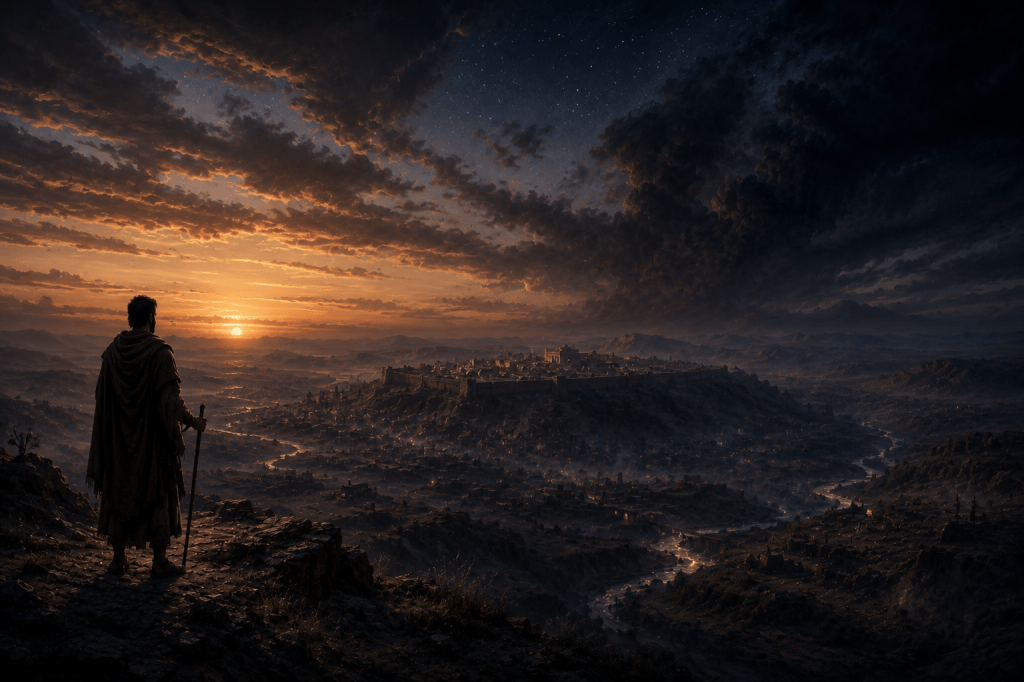
Every culture remembers the darkness differently.
WHEN MEMORY BECOMES MYTH
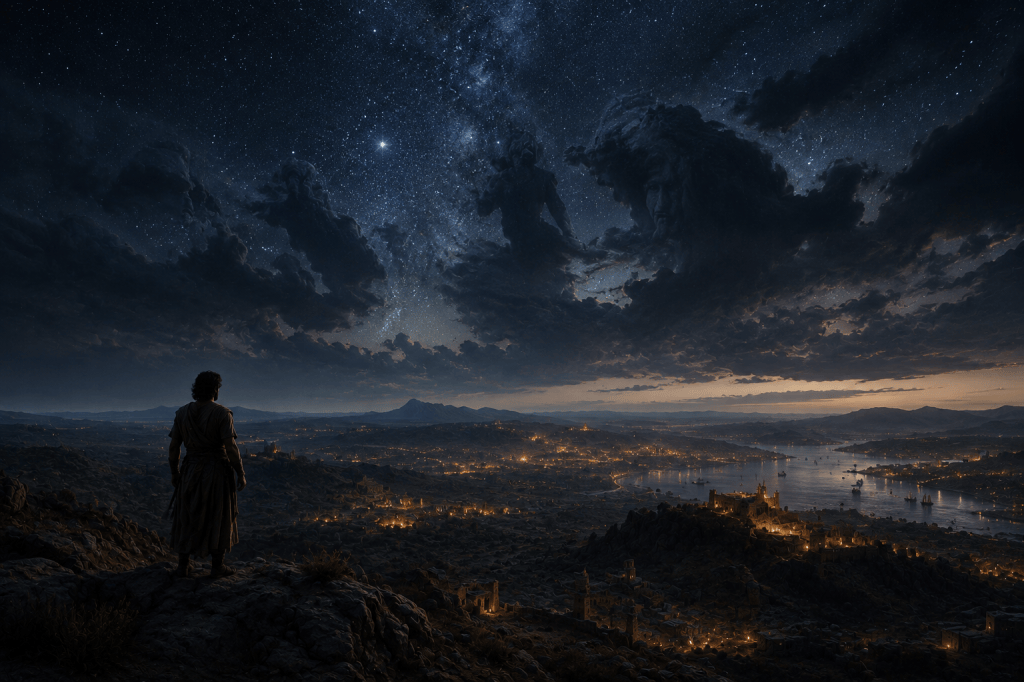
Myths rarely survive unchanged. They pass from one generation to another, crossing languages, kingdoms, and cultures along the way. Names change. Details disappear. New meanings are added. What begins as an encounter, an event, or an attempt to explain something beyond human understanding may eventually become legend.
In the world of Awaken The Dark, the great mythologies of the ancient world are not treated as interchangeable versions of the same religion. The Hebrews, Canaanites, Egyptians, and peoples of the distant north each possess their own beliefs, traditions, gods, and understanding of the cosmos. But none of them necessarily possesses the entire picture.
Some stories may preserve fragments of something older. A being remembered as a god in one culture might appear centuries later as a demon, spirit, giant, angel, or monster in another. The stories can contradict one another because the people telling them never understood everything they had encountered in the first place.
The myth may change. The thing that inspired it does not.
THE HEBREW SUPERNATURAL WORLD
To modern readers, the Hebrew Bible is often remembered primarily for its human history—patriarchs, judges, kings, prophets, wars, and kingdoms. Yet the world described within its pages is also profoundly supernatural. Angels carry messages and judgment. Cherubim guard sacred boundaries. Seraphim surround the divine throne. Spirits trouble kings. Giants appear among men. The dead descend to Sheol, while heavenly beings gather in the presence of Elohim.
Some passages offer only brief glimpses of this unseen world. Genesis speaks mysteriously of the “sons of God” and the Nephilim. The Psalms describe Elohim presiding among a divine assembly. Isaiah encounters six-winged seraphim crying out before the throne. Other texts speak of cherubim, heavenly armies, spirits, messengers, and beings whose precise nature is never fully explained. The biblical writers rarely stop to construct a complete supernatural hierarchy for the reader.
That ambiguity is important to Awaken The Dark. The novel does not attempt to replace the biblical supernatural world with a new mythology. Instead, it enters the spaces the ancient texts leave unexplained and asks what might exist between those scattered glimpses—and what human beings living within that world might actually perceive when something from beyond it steps into theirs.
BEINGS OF THE UNSEEN REALM
The ancient texts name them, but rarely explain them.
SERAPHIM
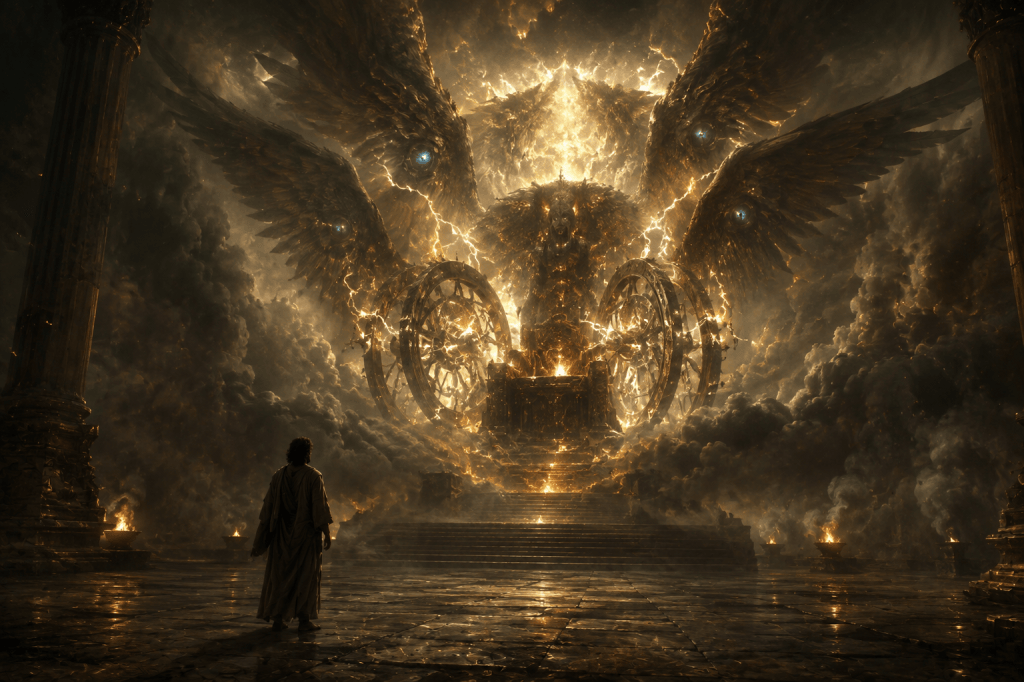
The seraphim appear most famously in Isaiah’s vision of the throne of Elohim. They are described as beings with six wings: two covering the face, two covering the feet, and two used for flight. Their voices shake the thresholds of the temple as they proclaim the holiness of the One upon the throne. Even their name carries an unsettling association—the Hebrew seraph is connected with burning, and elsewhere the same word is used in descriptions of fiery serpents.
They are therefore something far stranger than the gentle, human-shaped angels of later religious art. The biblical description suggests beings associated with fire, holiness, overwhelming power, and proximity to the divine presence—creatures before whom even a prophet is terrified by what he has seen.
Some things called angels were never described as human.
CHERUBIM
Cherubim are among the most frequently misunderstood beings in biblical tradition. They are not described as the small, winged children familiar from later Western art. In the Hebrew Bible, cherubim are powerful supernatural guardians associated with sacred space and the presence of Elohim. After humanity is expelled from Eden, cherubim guard the way to the Tree of Life. Images of them later overshadow the Ark of the Covenant, and biblical poetry even describes Elohim as enthroned above—or riding upon—the cherubim.
Their precise appearance is difficult to reconstruct from the biblical texts alone. Ezekiel’s extraordinary throne visions describe closely related composite beings with wings, multiple faces, and features drawn from humans and powerful animals. Whatever form the ancient writers envisioned, cherubim belonged to the boundary between the human and divine realms—guardians of places mankind was not permitted to enter freely.
They do not carry messages. They guard thresholds.
BENE ELOHIM — THE SONS OF GOD
The Hebrew phrase bene elohim, commonly translated “sons of God,” appears in several of the Bible’s most mysterious passages. In Job, these beings assemble before Elohim and are present when the foundations of the earth are laid. Genesis 6 describes the sons of God taking human women as wives shortly before the Flood—a brief and enigmatic passage connected with the appearance of the Nephilim.
Other biblical passages preserve glimpses of what many scholars understand as a heavenly or divine council: supernatural beings gathered beneath the authority of Elohim. Psalm 82 famously depicts Elohim standing within a divine assembly and passing judgment among other elohim. Exactly how ancient Israelites understood these beings—and how that understanding developed over time—remains a subject of considerable debate.
The heavens of the ancient world were not empty.
NEPHILIM & REPHAIM
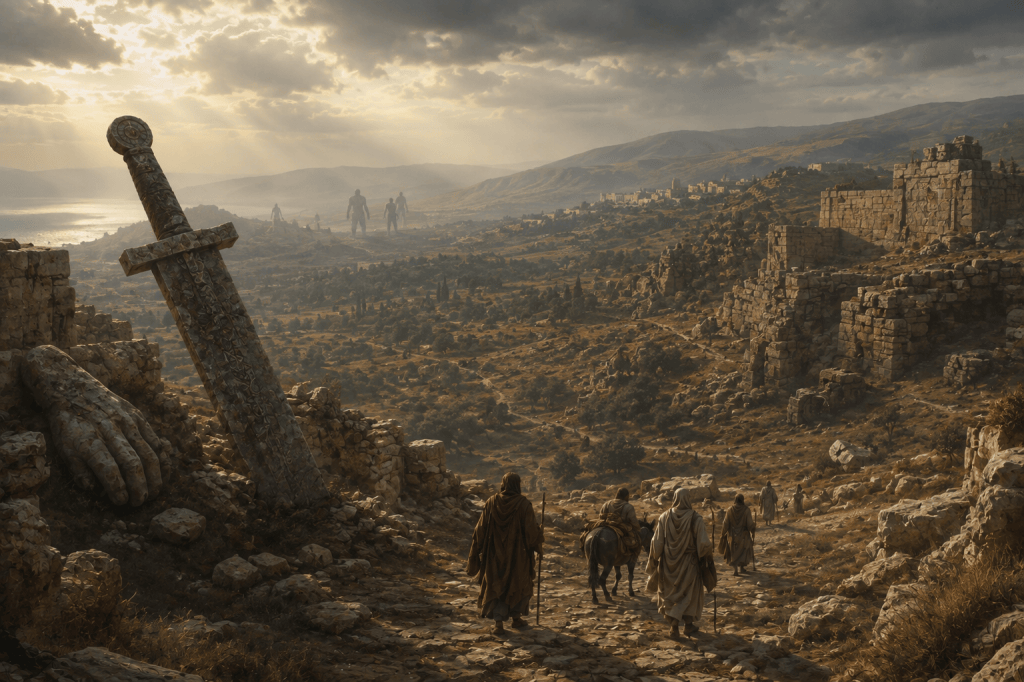
Few figures in the Hebrew Bible have inspired more speculation than the Nephilim. Genesis 6 mentions them in connection with the mysterious sons of God and the daughters of men before the Flood, describing them as mighty men of ancient renown. Numbers later invokes the name again when Israelite spies describe the terrifying inhabitants of Canaan and claim that they appeared like grasshoppers beside them. The texts say remarkably little about what the Nephilim actually were, leaving later generations to fill the silence.
The Rephaim belong to another ancient tradition associated with formidable peoples of the land. Biblical texts connect them with unusually powerful or imposing figures, including King Og of Bashan, while the term also develops associations with the dead or departed in other passages. By the age of David, echoes of these giant traditions remain especially strong among warriors associated with the Philistine city of Gath.
By David’s time, the age of giants was fading—but it had not disappeared.
THE GODS OF CANAAN
The peoples of Canaan imagined the divine world not as a collection of isolated gods, but as something resembling a great supernatural household. Texts discovered at ancient Ugarit preserve stories of a divine assembly populated by powerful beings with different authorities, rivalries, loyalties, and domains. At its head stood El, the aged patriarch and father figure of the gods, while other divine powers governed the storm, sea, death, fertility, warfare, and other forces upon which human life depended.
Among the most prominent was Baal, the storm-god whose struggle with Yam, the Sea, and Mot, Death, forms one of the great surviving mythic cycles of the ancient Near East. Athirat—better known through the Hebrew form Asherah—was associated with the divine family and motherhood, while goddesses such as Anat and Astarte were connected in different traditions with warfare, sexuality, fertility, kingship, and power. These traditions varied across centuries and communities; there was never a single, perfectly uniform “Canaanite religion.”
What makes these traditions especially fascinating beside the Hebrew texts is that they emerged from neighboring cultures that shared languages, imagery, and an ancient Near Eastern environment. Both preserve ideas involving divine assemblies, heavenly beings, cosmic conflict, sacred mountains, and the struggle between divine order and the chaotic sea. The similarities are real—but so are the profound differences in how those traditions ultimately understood Elohim, the gods, and the nature of divine authority.
Different gods. Different stories. The same ancient world.
EL — FATHER OF THE GODS
In the religious traditions preserved at Ugarit, El stands at the head of the divine family. He is portrayed as an ancient, wise, patriarchal figure—the father of gods and humanity and a source of authority within the divine assembly. Unlike the younger Baal, whose power is expressed through thunder, storms, and battle, El often appears as the elder ruler whose authority rests upon age, wisdom, and his position at the summit of the divine order.
The name itself is important. El is also a common Northwest Semitic word meaning “god,” and forms of it appear throughout the ancient Near East and within the Hebrew Bible—including in names such as Isra-el, Dani-el, and Micha-el. The biblical texts also use El as a designation for the God of Israel, alongside names and titles such as Elohim and YHWH. That shared vocabulary reflects the deeply interconnected linguistic and cultural world from which these traditions emerged.
Sometimes a name is a name. Sometimes it is a title. And sometimes, centuries later, it becomes difficult to know which came first.
ASHERAH / ATHIRAT
Known as Athirat in the texts from Ugarit and more commonly as Asherah in biblical discussions, she was an important goddess within the religious world of the ancient Levant. At Ugarit, Athirat appears as the consort of El and as a maternal figure within the divine family, sometimes described as the mother or progenitress of the gods. Her place within the pantheon reflects the familial structure through which Canaanite traditions often imagined the divine realm.
Asherah becomes particularly intriguing when we move from Canaanite religion into ancient Israel. The Hebrew Bible repeatedly condemns Asherah and objects associated with her worship, showing that her cult was a persistent presence within the religious landscape of Israel and Judah. Archaeological inscriptions from the Iron Age have made the subject even more controversial, including references to “YHWH and his asherah”—a phrase scholars continue to debate, particularly over whether asherah there refers to the goddess herself or to a cultic object associated with her.
The boundaries between Canaan and Israel were not always as clean as later history might suggest.
BAAL
Baal was among the most powerful and widely revered divine figures of the ancient Levant. His name means “lord” or “master,” and it could function as a title as well as refer to particular deities. In the mythology preserved at Ugarit, Baal—more specifically Baal Hadad—is the great storm-god: the bringer of thunder and rain whose power was inseparable from the fertility of the land and the survival of the people who depended upon it.
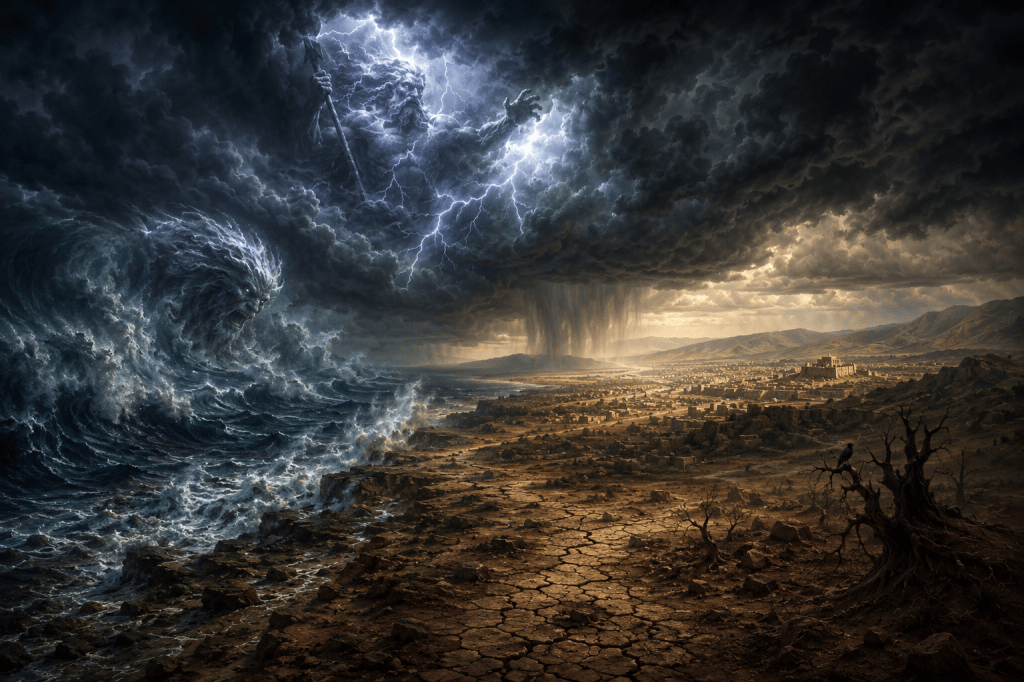
The surviving Baal Cycle portrays a divine world filled with conflict. Baal battles Yam, the personified Sea, and later confronts Mot, the embodiment of Death. His victories, defeat, disappearance, and return are bound to themes of kingship, rain, drought, fertility, death, and the restoration of life. In a land where the failure of seasonal rains could mean famine, these were not abstract ideas. The struggle of the gods mirrored the precarious world in which their worshippers lived.
When the rain itself meant life or death, the god who commanded the storm commanded fear as well as worship.
BAAL’S ENEMIES: SEA AND DEATH
In the Baal Cycle, some of Baal’s greatest enemies are not merely rival gods—they embody forces that ancient people could neither control nor escape. Yam represents the Sea: powerful, unpredictable, and associated with the chaotic waters that threatened the ordered world. Baal’s struggle against Yam therefore becomes more than a contest between divine personalities. It is a battle between order and chaos, kingship and an untamed primordial force.
Mot represents something even more inevitable: Death. He is portrayed as a terrifying power with an insatiable appetite, capable of swallowing the living and even bringing Baal himself into his realm. When Baal disappears, the land suffers with him; when the storm-god returns, fertility and life can return as well. The mythology binds together death, drought, rain, and renewal in a cycle the people of Canaan could see reflected in the land around them.
To the ancient world, death and chaos were not merely ideas. They could have names.
ANAT & ASTARTE — WAR, PASSION, AND POWER
Among the powerful goddesses of the ancient Levant, Anat and Astarte occupy overlapping but distinct places within the surviving traditions. Anat features prominently in the texts from Ugarit as a fierce divine warrior closely associated with Baal. She can be protective and loyal, but the surviving myths also portray her with extraordinary ferocity—an unsettling reminder that ancient ideas of divine power did not always fit comfortably within modern categories of good and evil.
Astarte—known elsewhere through forms of the name such as Ashtart and the biblical Ashtoreth—was worshipped across parts of the ancient Near East and Mediterranean world. Her associations varied considerably across cultures and periods, including sexuality, fertility, warfare, royal power, and divine protection. Like many ancient deities, there was no single description of Astarte that remained unchanged everywhere her name traveled.
Names can survive long after the stories attached to them have changed.
THE DIVINE ASSEMBLY
The gods of Canaan did not exist in isolation. The surviving myths describe them gathering, arguing, feasting, negotiating, and contending for authority within a divine assembly. El presides as patriarch, while other divine beings possess their own powers, loyalties, rivalries, and ambitions. The supernatural world often resembles a royal court—only one whose conflicts can determine whether the earth receives rain, suffers drought, or descends into chaos.
That image of a heavenly assembly becomes especially intriguing when placed beside passages in the Hebrew Bible that also describe supernatural beings gathering before Elohim. The traditions are not identical, and their understanding of divine authority differs profoundly, but both emerge from an ancient Near Eastern world in which the heavens could be imagined as inhabited by more than humanity’s supreme deity alone.
Perhaps the oldest question was never whether other beings existed—but what they truly were.
THE GODS OF THE NORTH — BEFORE THE VIKINGS
When most people hear “Norse mythology,” they imagine the Viking Age—the world of longships, raiders, skalds, and stories of Odin, Thor, Loki, and Ragnarök. But the Viking Age did not begin until the late eighth century AD, nearly eighteen centuries after the world in which Awaken The Dark is set. The great medieval texts that preserve much of Norse mythology were written down even later.
That does not mean the beliefs themselves suddenly appeared with the Vikings. Germanic religious traditions existed for centuries before they were committed to writing, changing as peoples migrated, languages developed, and stories passed from one generation to another. Archaeology, linguistics, Roman-era accounts, and comparative mythology provide glimpses of older traditions, but reconstructing precisely what people in northern Europe believed around 1000 BC is extraordinarily difficult.
That uncertainty creates one of the most important spaces within the mythology of Awaken The Dark. The novel does not imagine Vikings living in the age of David. Instead, it asks whether some of the beings, places, and stories eventually preserved in Norse mythology might themselves be far older than the people who finally gave them the names by which we remember them.
What if Odin was not the beginning of the story—but one of its later names?
ODIN — THE WANDERER
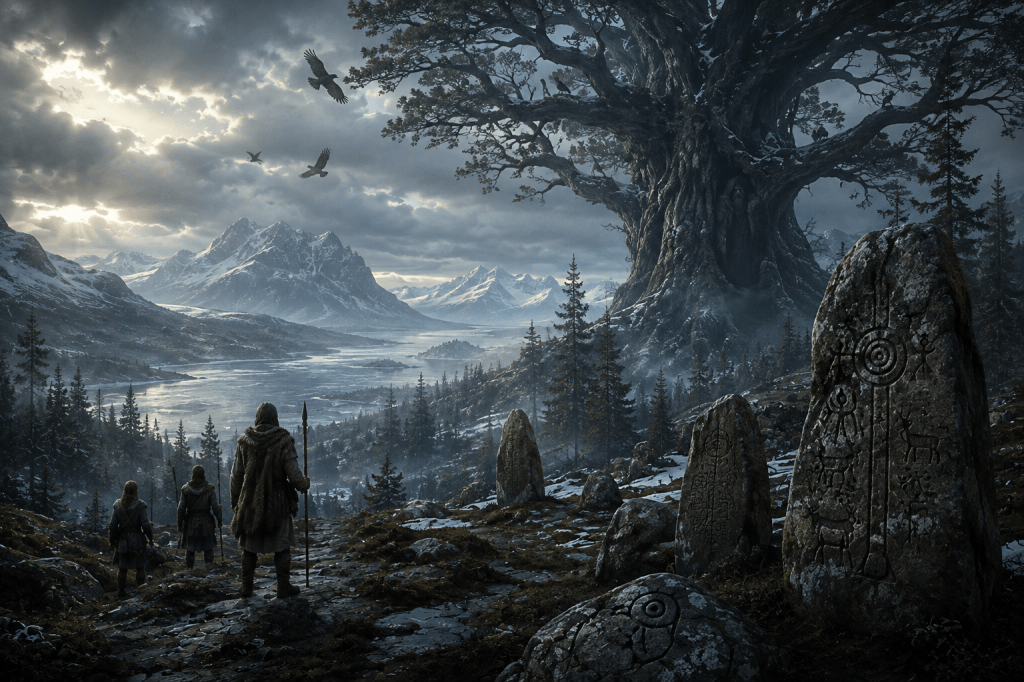
The Odin preserved in later Norse tradition is a complicated figure: ruler, wanderer, warrior, poet, magician, seeker of wisdom, and god of the slain. Unlike a simple all-powerful king of the gods, Odin is defined by what he is willing to sacrifice in pursuit of knowledge. He gives an eye for wisdom, hangs upon the World Tree in his quest for the runes, and continually travels beyond the safety of his own realm seeking knowledge of what is hidden.
Two ravens, Huginn and Muninn—often translated as Thought and Memory—fly throughout the worlds and return to him with what they have seen. Wolves accompany him. The dead gather in his hall. Yet even Odin cannot escape fate: the surviving myths portray him as knowing that Ragnarök is coming and still searching relentlessly for knowledge that might prepare him for it.
What kind of being searches for knowledge when he already knows how the story ends?
YGGDRASIL — THE WORLD TREE
At the center of Norse cosmology stands Yggdrasil, the immense World Tree whose roots and branches bind together the supernatural landscape. Gods, giants, humans, the dead, and other beings inhabit realms associated with this cosmic structure. Creatures dwell among its roots and branches, while the gods themselves gather near it and travel between the worlds connected through it.
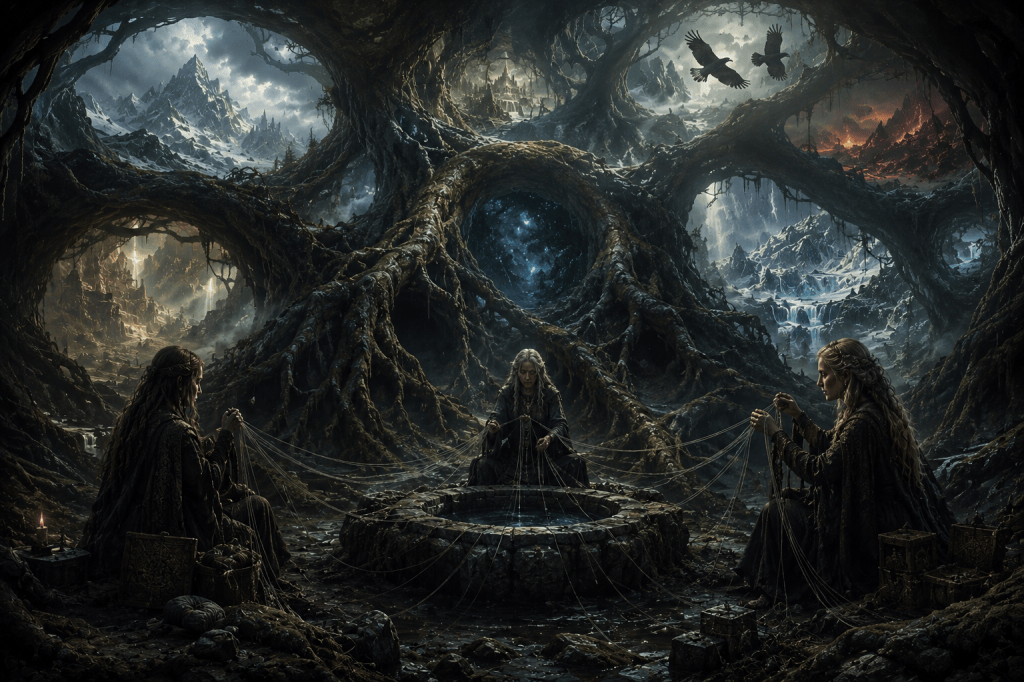
Yggdrasil is not merely a road between places. It is bound to life, death, knowledge, and fate. Odin hangs upon the tree in his terrible quest for the runes, sacrificing himself to himself in exchange for hidden wisdom. Beneath its roots lie ancient wells, and there the Norns shape the destinies of gods and men while the tree itself endures the forces continually threatening the ordered cosmos.
The familiar idea of the “Nine Worlds” comes to us through much later Norse sources, and those texts never provide the neat map of nine separate realms that modern diagrams often suggest. What exactly these worlds were, how they related to one another, and how ancient people imagined passage between them is far less certain than popular mythology sometimes makes it appear.
What if the worlds were never meant to be places on a map?
THE NORNS — WEAVERS OF FATE
Near the roots of Yggdrasil, later Norse tradition places three mysterious figures: Urðr, Verðandi, and Skuld. Their names are commonly associated with what has become, what is becoming, and what shall be. Together they are known as the Norns, beings intimately connected with fate and the destinies of gods and men.
The surviving traditions suggest that the Norns do more than simply predict the future. They shape or establish destiny, carving or determining the courses allotted to lives. Norse literature also speaks more broadly of norns attending individuals and influencing their fortunes, suggesting that the three famous figures may represent only the most prominent expression of a much larger idea. Even the gods live beneath the shadow of what has been ordained.
Yet fate in Norse mythology does not necessarily make choice meaningless. A warrior may know death awaits him and still choose how he meets it. Odin may know Ragnarök is coming and still seek knowledge, gather warriors, and prepare. The destination may be fixed while the choices made along the road remain profoundly important.
If the ending is already known, are the choices that lead to it still your own?
HUGINN & MUNINN — THOUGHT AND MEMORY
In later Norse tradition, Odin is accompanied by two ravens: Huginn and Muninn, whose names are commonly understood as “Thought” and “Memory.” Each day they fly across the world, observing what they find before returning to Odin and telling him what they have seen. Through them, the wandering god extends his sight far beyond wherever he happens to stand.
Ravens already possessed powerful associations with battle, death, and the aftermath of war in the ancient world, but Huginn and Muninn are something more specific: watchers. They cross great distances, gather knowledge, and return with information hidden from their master’s immediate sight. In the surviving Norse poetry, Odin even expresses concern that one day they might not return.
In Awaken The Dark, the ravens are watching too.
LOKI — THE BRINGER OF CHAOS
Few figures in Norse mythology resist simple definition as thoroughly as Loki. He moves among the gods but never fits comfortably among them. Clever, deceptive, charismatic, and dangerously unpredictable, he repeatedly creates disasters for the Æsir—yet just as often uses his cunning to rescue them from problems he helped create. He changes shape, crosses boundaries, challenges authority, and seems almost instinctively drawn toward disorder.
As the surviving stories progress, however, Loki’s mischief becomes something darker. He is associated with the death of Baldr, is bound by the gods as punishment, and ultimately breaks free at Ragnarök to stand against them. His children include some of the most terrifying beings in Norse mythology: Fenrir, the great wolf; Jörmungandr, the serpent encircling the world; and Hel, ruler of the realm of the dead. Loki therefore occupies an unusual place between companion, outsider, trickster, enemy—and agent of catastrophe.
But these stories were written down centuries after the world of Awaken The Dark. What Loki may have represented in much earlier traditions is considerably harder to recover. His origins remain debated, and attempts to reduce him to a simple “god of fire,” “god of evil,” or even “god of chaos” go beyond what the surviving evidence can securely tell us.
Some names change as they travel through time. Others become almost unrecognizable.
THE SHADOW BETWEEN THE MYTHS
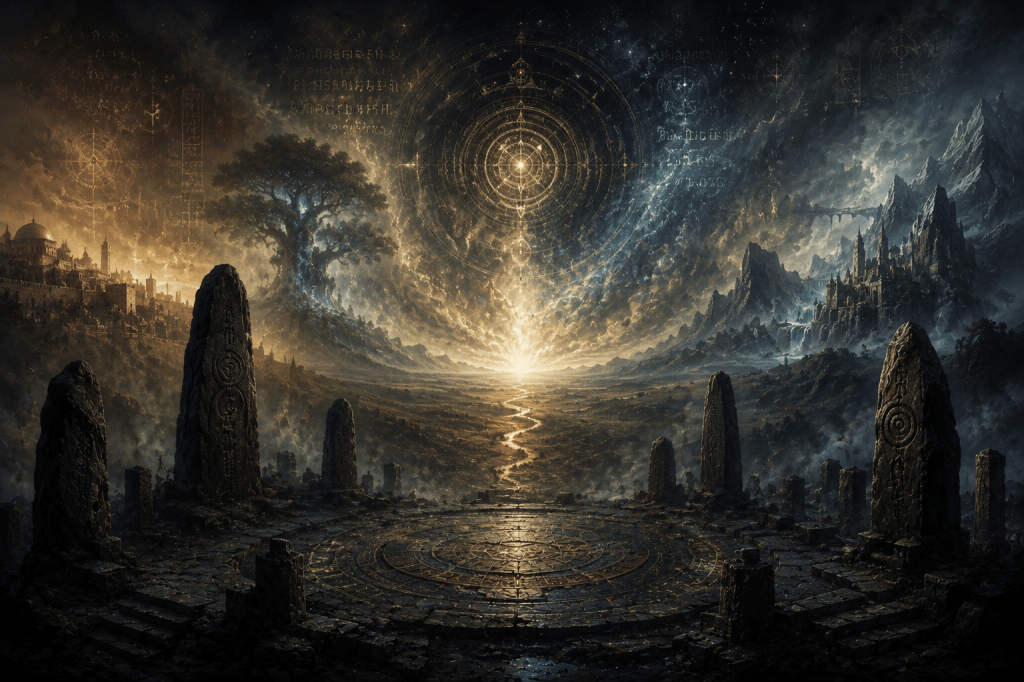
Across these traditions, certain ideas appear again and again. Divine beings gather in councils. Chaos threatens order. Other realms exist beyond the ordinary world. The dead travel somewhere beyond human sight. Watchers cross boundaries. Ancient powers are imprisoned, released, forgotten, and remembered beneath different names.
History explains many of these similarities through geography, shared ancestry, cultural exchange, migration, and the simple fact that human beings everywhere wrestle with the same mysteries. Awaken The Dark does not reject those explanations. But within the world of the novel, another possibility exists alongside them.
What if some myths resemble one another because, somewhere beneath the stories, humanity encountered the same things?
THE GOD BEHIND THE GODS
More than a thousand years after the age of David, a collection of religious movements now broadly described as Gnostic began preserving a radically different vision of the cosmos. In several of these traditions appears a strange and deeply unsettling figure: Yaldabaoth, a creator or ruler associated with the material world who exists in ignorance of a greater divine reality beyond himself.
The surviving accounts differ, but Yaldabaoth is often portrayed as arrogant, jealous, and convinced of his own supremacy. Some traditions describe him with extraordinary imagery, including the form or features of a lion and serpent. He belongs to a complex cosmology of higher divine realities, emanations, rulers, and realms that developed centuries after the biblical world in which Awaken The Dark begins. There is no historical evidence that the people of Jebus—or anyone living in Canaan around 1000 BC—knew the name Yaldabaoth.
But that historical distance creates one of the central questions behind the mythology of Awaken The Dark. A name can be younger than the thing humanity eventually uses it to describe.
Humanity did not create Yaldabaoth when it finally gave him a name.
OLDER THAN THE NAMES
The gods belong to religions. The beings behind them may not. Within the mythology of Awaken The Dark, terms such as Hebrew, Canaanite, Norse, Egyptian, and Gnostic describe human traditions—not necessarily the origins of the supernatural powers those traditions attempt to explain.
A being encountered in one age might be worshipped as a god. Centuries later, another culture could encounter that same power—or merely inherit distorted memories of it—and understand it as something entirely different. A divine name might become a title. A title might become a legend. A legend might survive long after anyone remembers what first inspired it.
That is why chronology becomes deceptive. A name first written in a late manuscript does not necessarily mark the beginning of the being who bears it within the world of the novel. Nor does a story preserved in the north necessarily mean that the thing behind the story originated there.
The myths have origins. The beings have histories. They are not always the same thing.
THE SHADOW REALM
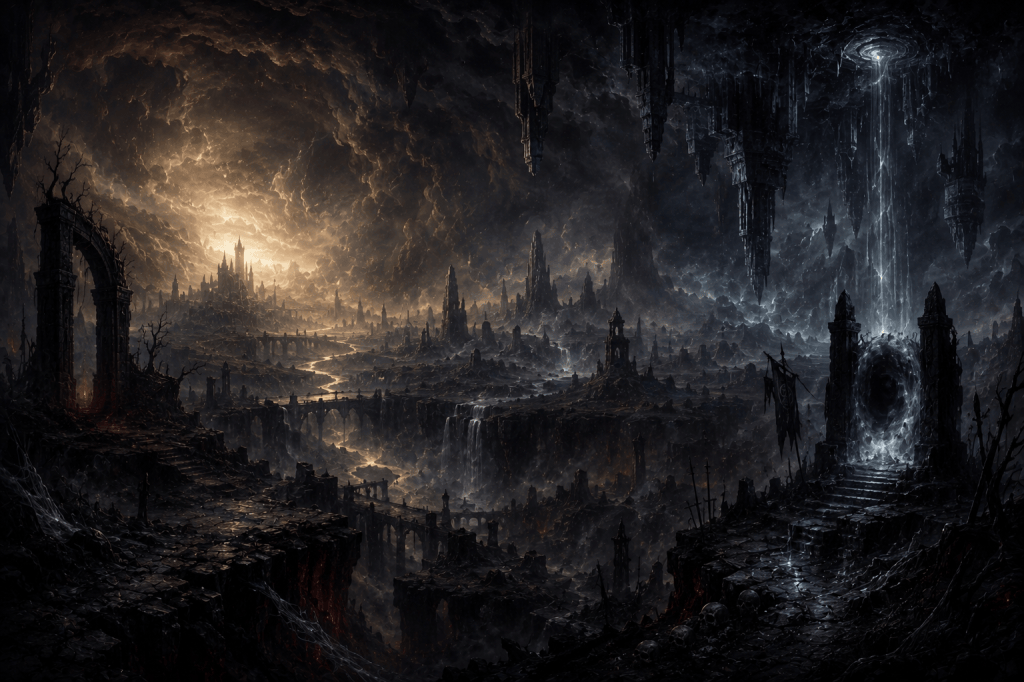
The world of the living is not the only realm that exists within Awaken The Dark. Beyond the boundaries of ordinary human perception lies another place—a dark reflection of the physical world where familiar landscapes can become distorted, hostile, and profoundly unnatural. The novel calls it the Shadow Realm.
It is not simply Hell, nor is it meant to be identified directly with Sheol, Hel, or any single underworld described by ancient religion or mythology. Yet stories of journeys beyond the world of the living appear across cultures: lands of the dead, hidden realms, places reached through dreams, visions, caves, sacred boundaries, or passages from which the traveler may never return unchanged.
The Shadow Realm exists somewhere within that uncertainty. At times it seems impossibly distant. At others, the boundary between it and the physical world becomes frighteningly thin. Places may echo across that boundary, and what occurs on one side can leave consequences upon the other. But like the people who encounter the supernatural throughout the story, the characters understand only fragments of what the Shadow Realm truly is.
How many ancient stories of other worlds began with someone glimpsing the same place?
WHEN DARKNESS FINDS A NAME
The supernatural forces within Awaken The Dark are dangerous, but they do not exist apart from the people who encounter them. Power can tempt. Grief can distort. Fear can become hatred. Ambition can become obsession. And sometimes the most terrible influence does not create darkness within a person—it discovers what is already there.
That distinction matters. The characters are not merely pieces moved across a board by gods, spirits, or ancient powers. They make choices. They love, betray, forgive, envy, sacrifice, doubt, and believe. The supernatural may influence those choices, exploit them, or magnify their consequences, but it does not erase the human being who makes them.
That is where the mythology of the story ultimately becomes personal. The greatest struggle is not simply between one god and another, one kingdom and another, or even the physical world and the Shadow Realm. It is the struggle between what exists beyond humanity—and what already exists within it.
Darkness rarely enters an empty place.
THE STORIES BENEATH THE STORY
The world of Awaken The Dark begins with history. Jebus existed. David, Saul, Jonathan, and Goliath belong to the ancient traditions preserved in the biblical record. Kingdoms rose and fell across Canaan. Peoples fought over land, water, trade, and survival. Archaeology continues to uncover pieces of that world while leaving other questions unanswered.
Around that history survived something else: stories of giants, heavenly beings, divine councils, gods of storm and death, distant realms, watchers, spirits, and powers whose names changed as civilizations disappeared and new ones took their place. Some belong to texts written near the ancient world of the novel. Others survive only in traditions recorded centuries—or even millennia—later.
The Shadow of Death Trilogy lives in the space between those things. It does not ask the reader to believe that mythology is history, or that every ancient religion was secretly describing the same gods. It asks something smaller—and perhaps more unsettling: what if humanity occasionally encountered something it could not understand, and myth is what remained after history forgot?
History remembers what happened.
Myth remembers what we could not explain.
Somewhere between them, the darkness awakens.