
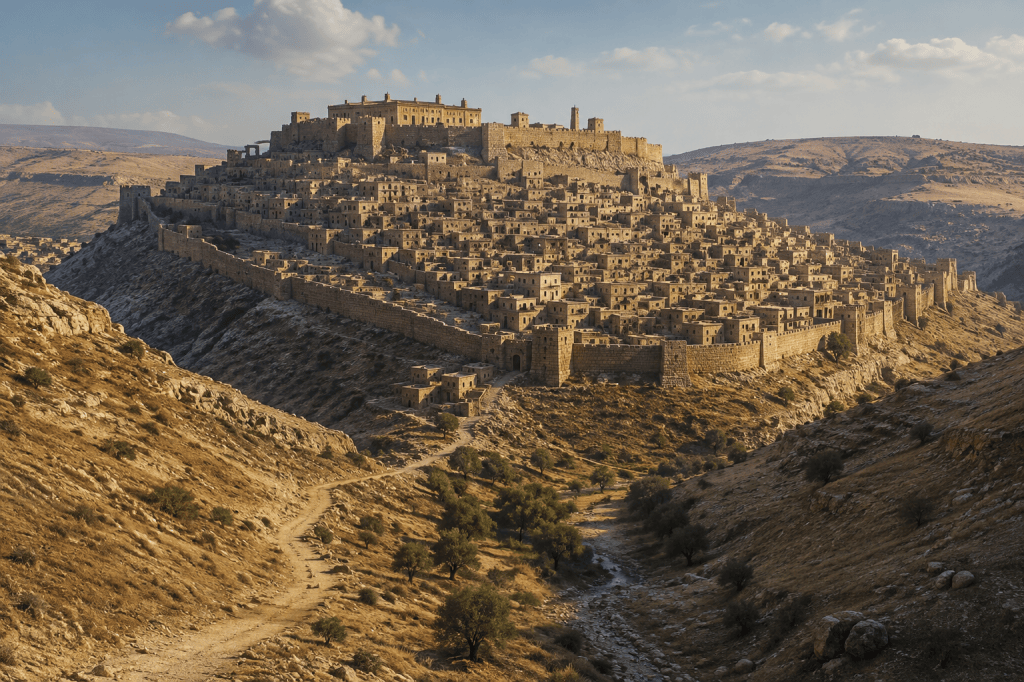
Most people know Jerusalem. Far fewer know Jebus.
Long before David captured the city and made it the political heart of his kingdom, Jebus already stood on the narrow ridge above the Kidron Valley—a fortified Canaanite stronghold with its own rulers, defenses, water systems, traditions, and gods.
That older city is where Awaken The Dark begins. And once you start looking closely at the history surrounding it, something interesting happens: the line between what we know, what ancient people believed, and what later generations remembered begins to blur.
BEFORE JERUSALEM, THERE WAS JEBUS
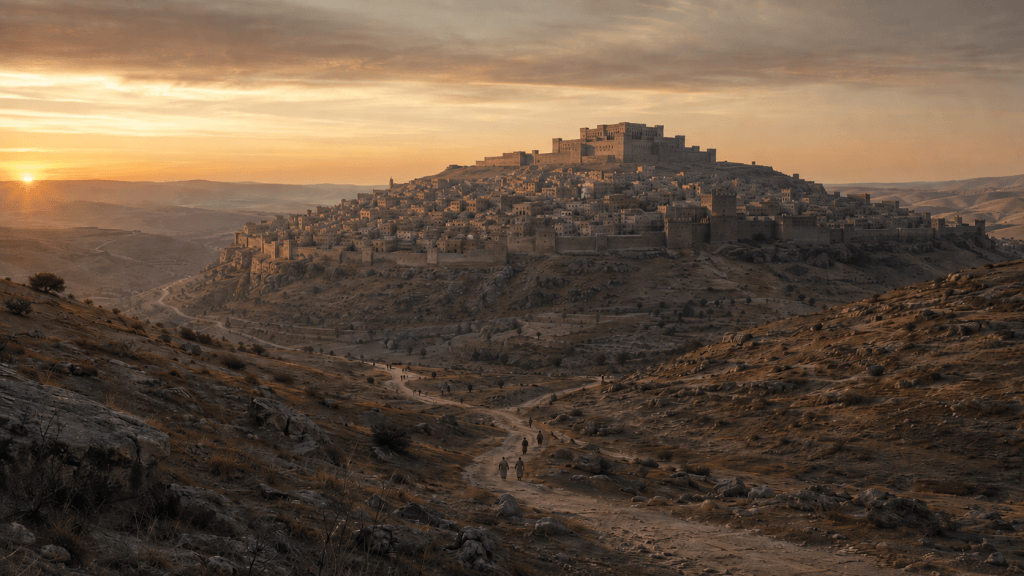
By the time David arrived, Jebus was already old. Its position on a narrow ridge, protected by steep valleys and supplied by the Gihon Spring, made it a formidable stronghold in the central hill country. The city was not the sprawling Jerusalem of later history. It was smaller, tighter, and built around survival.
The biblical record preserves Jebus as a city that remained outside Israelite control for generations. Even as the surrounding political landscape changed, the Jebusites held their ground. That stubborn independence is part of what made the city so important when David began looking for a capital that could unite the tribes under his rule.
For Awaken The Dark, that historical setting matters. Jebus is not simply a backdrop waiting for David to conquer it. It is a living city filled with families, rivalries, traditions, fears, and people who have no idea that history already remembers their home by another name.
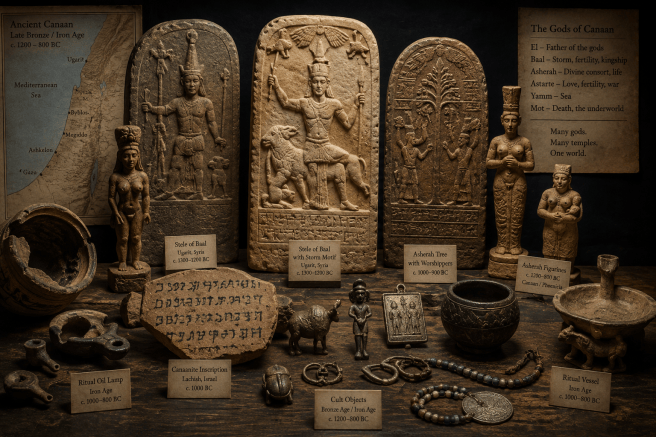
CANAAN WAS ALREADY A WORLD FILLED WITH GODS
To the people of ancient Canaan, the supernatural was not separate from everyday life. The gods were woven into the world around them—into rain and drought, warfare and harvest, fertility and death. Divine favor could explain victory. Divine anger could explain catastrophe.
The religious traditions preserved from the wider Canaanite world speak of gods such as El, Baal, Asherah, Anat, Astarte, Yam, and Mot. Their stories describe divine families, rivalries, battles, councils, and struggles over the forces that governed human survival. In a land where the failure of rain could mean famine, a storm-god was not merely symbolic.
Exactly what the people of Jebus worshipped in the age of David is harder to know. The city has left us no surviving religious archive comparable to places such as Ugarit. What remains is a mixture of archaeology, biblical references, and comparison with neighboring cultures—a record incomplete enough to leave room for questions.
WHEN HISTORY BECOMES MYTHOLOGY
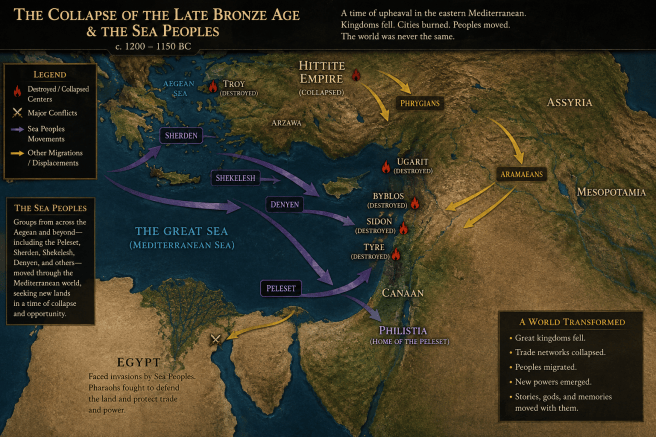
Around 1200 BC, the eastern Mediterranean world was shaken by a series of collapses that brought down kingdoms, disrupted trade, destroyed cities, and transformed the political map of the region. Historians still debate the precise causes, but warfare, migration, internal revolt, drought, famine, and the movements of groups remembered collectively as the Sea Peoples all appear to have played a part.
Among the peoples who emerged from that upheaval were the Peleset, widely associated with the Philistines of the biblical world. By the age of Saul and David, the Philistines had become one of the dominant military powers of the southern Levant, centered around cities such as Gaza, Ashkelon, Ashdod, Ekron, and Gath.
That historical movement is important to Awaken The Dark because it places the story in a world already shaped by catastrophe, migration, and cultural memory. Peoples had crossed seas, kingdoms had vanished, and stories had traveled with the survivors. History was being carried from one civilization into another—and with it, perhaps, things that were harder to explain.
WHAT IF MYTHS REMEMBER SOMETHING?
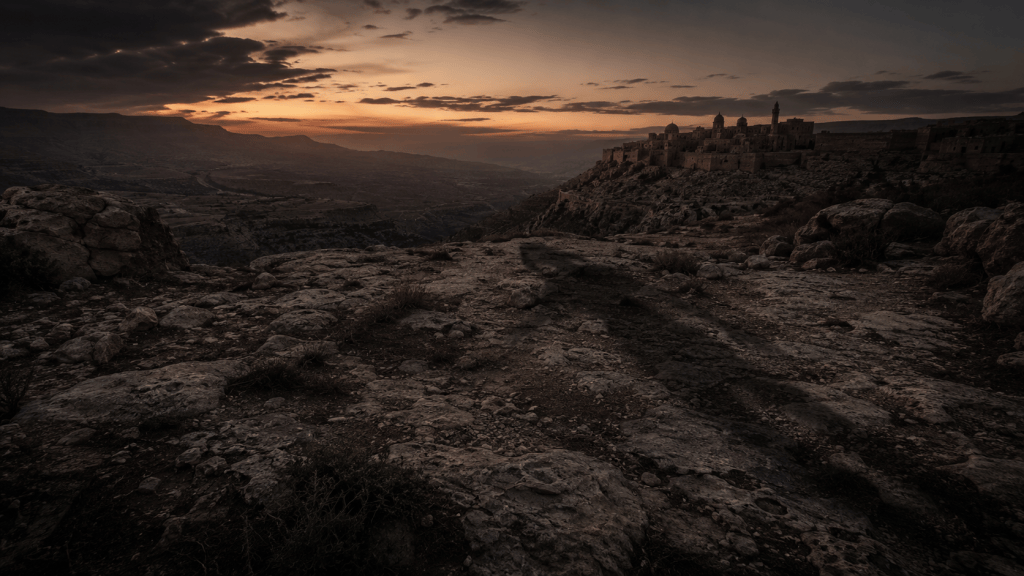
Ancient people did not separate the natural and supernatural worlds the way modern readers often do. A storm could be weather—and the action of a god. A victory could result from strategy—and divine favor. A dream might be imagination—or a warning. To the people who lived within those cultures, the unseen world was not fantasy. It was part of reality.
That does not mean every ancient myth should be read as literal history. Stories change as they travel. Names are translated. Details are forgotten. One culture reshapes what it inherits from another. But myths can preserve memories long after the events, beliefs, or encounters that produced them have disappeared.
That possibility became one of the foundations of Awaken The Dark: what if some of the oldest stories are distorted reflections of things humanity once encountered but never fully understood?
What if mythology is not the opposite of history—but one of the ways humanity remembers what history could not explain?
THE SHADOW OF DEATH
The Hebrew phrase tsalmaveth is traditionally translated as “shadow of death” or “deep darkness.” It appears in some of the Bible’s most haunting passages, including the familiar language of Psalm 23: “the valley of the shadow of death.”
In Awaken The Dark, that phrase becomes something more. Tsalmaveth is not merely an image of danger, fear, or death. It is the name given to an ancient supernatural being whose presence has moved through human history largely unseen.
That transformation—from poetic phrase to character—captures the larger method behind the novel’s mythology. A word preserved in scripture becomes the doorway to a much older question: what if some expressions that later generations understood symbolically once described something far more literal?
Sometimes a shadow is only a shadow. Sometimes it is watching back.
THE DAY ISRAEL LOST THE ARK
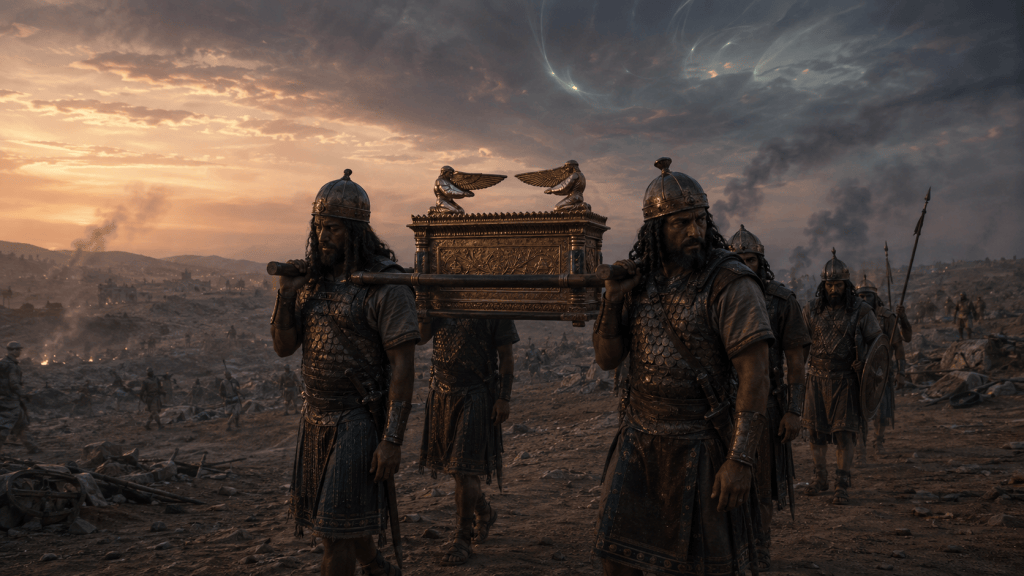
According to 1 Samuel 4, Israel went to battle against the Philistines near Ebenezer and suffered a devastating defeat. After roughly four thousand men were killed, the elders of Israel made a decision that seems almost desperate in hindsight: they sent to Shiloh for the Ark of the Covenant, believing its presence would guarantee victory.
When the Ark entered the Israelite camp, the soldiers shouted so loudly that the ground seemed to shake. Across the battlefield, the Philistines heard the noise and learned that the God of Israel had come into the camp. They were terrified. They remembered what Israel’s God had done to Egypt—and then, instead of retreating, they prepared to fight.
What followed was catastrophe. Israel was defeated again. The sons of Eli, Hophni and Phinehas, were killed, and the Ark itself was captured by the Philistines.
For Israel, the Ark was far more than a sacred chest. It represented the earthly throne-footstool of Elohim—the invisible King enthroned above the cherubim. Its capture would therefore have seemed almost unimaginable: not merely the loss of a religious object, but the apparent seizure of the very symbol of Elohim’s presence and kingship among His people.
And yet the biblical story makes something else clear. Elohim was not defeated. He did not need Israel’s army to defend him, and he did not cease to rule because the Ark crossed into Philistine territory. The events that follow—the humiliation of Dagon and the calamities surrounding the Ark—turn what looks like divine defeat into something far more unsettling. The question is no longer whether Elohim lost control. The question is why he allowed the Ark to be taken at all.
WHAT IF SOMETHING ELSE WAS INSIDE?
That question became one of the most important points of departure for Awaken The Dark. The biblical story tells us what happened to the Ark. It does not tell us every reason Elohim may have allowed those events to unfold—or what else might have been carried with it.
In the mythology of the novel, Tsalmaveth has been imprisoned within an angelically bound stone prison associated with the Ark. He experiences its capture from within, expecting divine intervention and gradually realizing that none is coming. The Philistines are not stealing something Elohim has failed to protect. They are carrying it exactly where they have been permitted to carry it.
That changes the entire meaning of the episode. What looks like defeat from the battlefield may be part of something much larger, and Tsalmaveth is forced to confront a terrifying possibility: perhaps the movement of the Ark is not merely happening around him. Perhaps, in some way he cannot yet understand, it is happening because of him.
What if the Ark was not only being captured? What if it was carrying something toward its appointed place?
IF GOD KNOWS WHAT YOU WILL CHOOSE, ARE YOU STILL FREE?
The capture of the Ark raises a question that reaches far beyond the battlefield at Ebenezer. If Elohim knew what Israel would do, knew how the Philistines would respond, and knew where the Ark would ultimately travel, were the people involved still making genuine choices?
The elders chose to bring the Ark from Shiloh. The Philistines chose to stand and fight despite their fear. They chose to seize the Ark after the battle. Later, overwhelmed by what followed, they chose to send it away. None of those decisions needed to be forced in order for Elohim to know where they would lead.
That tension between foreknowledge and freedom runs beneath Awaken The Dark. The characters are not puppets. They act from loyalty, fear, ambition, grief, faith, jealousy, courage, and desire. Their choices belong to them—even when those choices lead toward an outcome that may already be known by something far greater than themselves.
Knowing the road someone will choose is not necessarily the same as choosing it for them.
HISTORY GIVES AWAY THE ENDING
Anyone who knows the Biblical story already knows that Jebus will fall. David will take the stronghold, Jerusalem will rise in its place, and the city will become one of the most important places in human history. In that sense, the ending is already written.
But knowing how history ends is not the same as knowing what it felt like to live through it. The people inside Jebus do not know they are standing on the edge of someone else’s history. They do not know which decisions will matter, which loyalties will survive, or which names will be remembered centuries later.
That is where historical fiction becomes most powerful. It allows us to enter the space between the record and the lived experience—to imagine the fear, faith, ambition, grief, and uncertainty that history compresses into a few surviving lines.
History tells us what happened. Stories let us ask what it meant to the people who were there.


Leave a Reply