
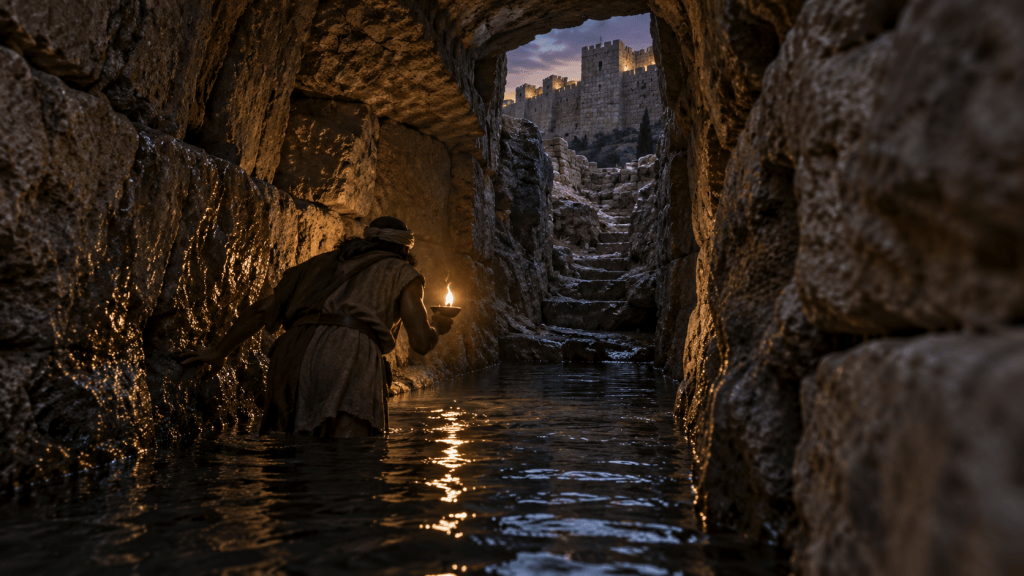
Ancient walls protected the city that would become Jerusalem. Beneath them ran a hidden world of springs, channels, pools, and passages—and possibly the route by which David’s soldiers entered Jebus.
Before Jerusalem became the City of David, it was Jebus: a fortified Canaanite stronghold built upon a narrow ridge above the surrounding valleys.
Its position alone made it formidable. The Kidron Valley fell sharply along its eastern side, while other natural slopes helped protect its approaches. Walls strengthened the terrain’s defenses. From above, Jebus could watch an enemy struggle uphill before that enemy ever reached the city gates.
The biblical account captures the confidence of its inhabitants. When David approached the city, the Jebusites taunted him that even their “blind and lame” could keep him out. Whether this was a proverb, an insult, or language carrying some meaning now lost to us, its message is clear: the defenders believed Jebus could not be taken.
Yet David captured it.
The Bible tells us who won. It gives us the name of the man who led the attack. But it leaves behind a tantalizing mystery about how the city’s defenses were breached.
The answer may lie beneath the earth.
A Fortress with a Vulnerable Lifeline
Every fortified city faced the same unavoidable problem: water.
Walls could keep soldiers out, but they could not create a spring inside the city. During a siege, an exposed water source could become a city’s greatest weakness. If attackers captured it, blocked it, or kept residents from reaching it, even the strongest walls would eventually become useless.
Jebus depended on the Gihon Spring, located on the eastern slope of the ridge above the Kidron Valley. The spring gave the city the water it needed, but its location also created a defensive problem. The people had to be able to reach it without exposing themselves to an attacking army.
Over many centuries, Jerusalem’s inhabitants altered the area around the spring. They cut channels into the rock, created pools and passages, and built massive defenses around the water source.
Some features carried water toward fields. Others controlled or collected its flow. Protected passages allowed people to descend from the settlement toward the spring.
But these features were not all built at the same time. Jerusalem was occupied, rebuilt, and expanded for centuries. Later rulers repaired old structures and added new ones.
That makes it difficult to look at the tunnels beneath Jerusalem today and decide which passages David’s soldiers might have encountered.
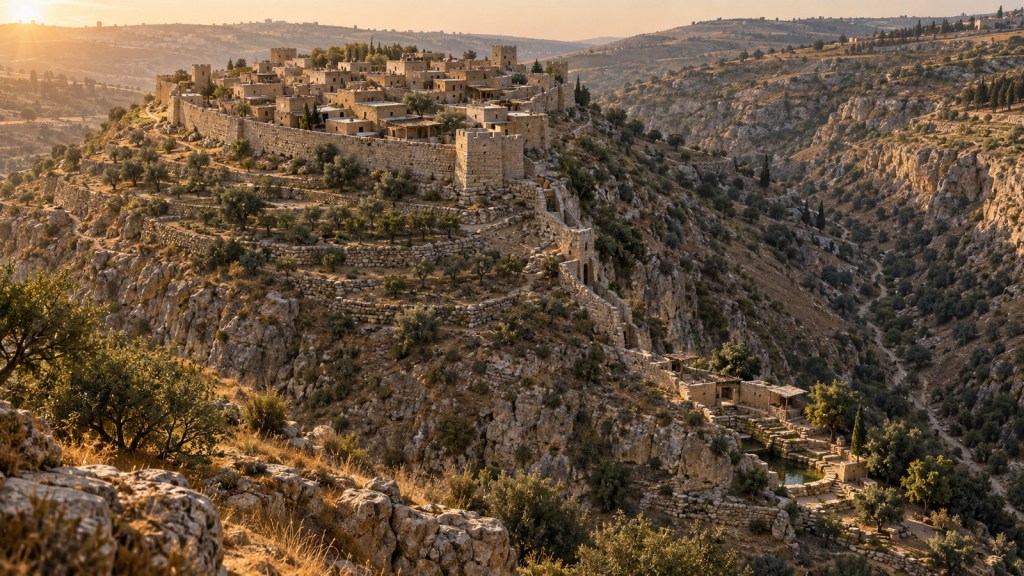
The famous tunnel associated with King Hezekiah belongs to a much later period. It could not have been the route used during David’s conquest. But features from different centuries are easily blended together when the story is retold.
To understand what David’s soldiers might have encountered, we have to ask which passages were actually open and accessible near the beginning of the first millennium BCE.
That question remains disputed.
The Mystery of the Tsinnor
Much of the mystery comes from one Hebrew word: tsinnor.
In 2 Samuel 5:8, David challenges his men to strike the Jebusites and reach or use the tsinnor. Many English Bibles translate the word as “water shaft.”
That translation gives us a vivid picture. We imagine Joab entering through the spring, following an underground passage, climbing a shaft, and appearing inside the city.
The problem is that no one knows for certain what tsinnor meant in this passage.
Other translations have used words such as “gutter” or “watercourse.” The word appears only once elsewhere in the Hebrew Bible. In Psalm 42:7, it describes rushing or falling water. That tells us the word probably had some connection with water, but it does not tell us exactly what kind of channel, shaft, or structure David meant.
The account in 1 Chronicles makes the mystery even more interesting. It says Joab led the attack and became commander, but it does not mention the tsinnor or explain how he entered the city.
David attacked Jebus.
The defenders believed their city was secure.
Joab led the decisive assault.
The city fell.
David made the captured fortress his capital.
The route of entry remains hidden inside one difficult word.
Warren’s Discovery
In 1867, British officer and explorer Charles Warren investigated the underground passages near the Gihon Spring. There he encountered the vertical feature now known as Warren’s Shaft.
The discovery seemed to offer a dramatic answer to the biblical mystery. Perhaps Joab and David’s men had entered near the spring, followed an underground passage, climbed the shaft, and emerged inside the city.
It was a compelling explanation. It connected a real archaeological feature to the mysterious tsinnor and turned a brief biblical reference into a vivid military operation.
For many years, this became the familiar explanation of David’s conquest.
Later excavations complicated it.
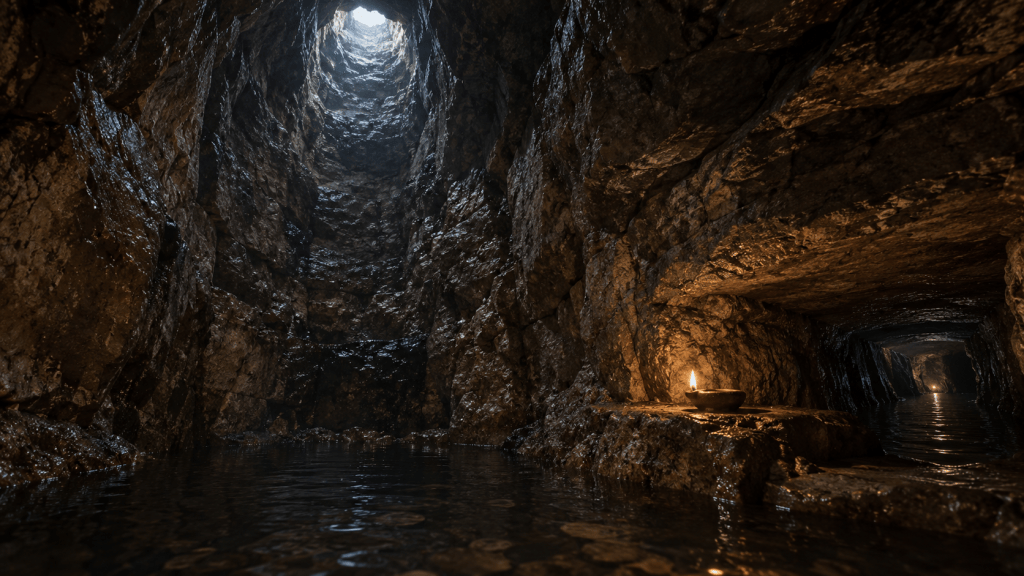
Artistic reconstruction of the natural shaft and adjoining passages near the Gihon Spring. Whether this was David’s route into Jebus remains disputed.
Archaeologists Ronny Reich and Eli Shukron found evidence that the water system developed in several stages. Their work raised doubts about whether the upper opening of Warren’s Shaft was exposed and accessible during the period traditionally associated with David.
If their reconstruction is correct, Joab could not have climbed through it.
That does not rule out every underground possibility. Other channels and protected passages existed around the Gihon Spring. The tsinnor could have referred to one of those—or to something whose meaning has been lost.
Warren’s Shaft remains an important part of Jerusalem’s underground landscape. It simply may not be the answer people once believed it was.
What Archaeology Has Uncovered
Excavations around the Gihon Spring uncovered evidence of enormous ancient construction.
Archaeologists found massive stone defenses, a protected passage leading toward the water, and structures connected to a nearby rock-cut pool. Some of the walls were built from exceptionally large boulders.
This was more than a convenient path to a spring. The people living in Jerusalem invested a huge amount of labor in protecting their water supply because the city could not survive without it.
The difficult question is when these defenses were built.
They were traditionally dated to the Middle Bronze Age, many centuries before David. That dating was based partly on the construction style, nearby archaeological material, and the relationship between the different structures. If that date is correct, the defenses around the spring were already old when David attacked Jebus.
A 2017 radiocarbon study challenged part of that timeline. Researchers tested material found beneath foundation stones at the northeastern corner of the Spring Tower. Some results extended into the ninth century BCE—later than the period traditionally associated with David. The researchers argued that at least the section they tested might have been built later than previously believed.
Archaeologist Ronny Reich disagreed with that conclusion. He argued that the samples did not necessarily date the tower’s original construction. They might instead reflect later repairs, rebuilding, flooding, or changes made to one part of an older structure.
The disagreement does not mean that nothing is known.
We know ancient waterworks existed around the Gihon Spring. We know massive defenses protected the area. We know channels and passages connected the spring to the life of the settlement.
What remains uncertain is exactly which walls, openings, and routes were accessible when David captured the city.
Archaeology gives us pieces of Jebus. It does not give us an eyewitness account of the moment the city fell.
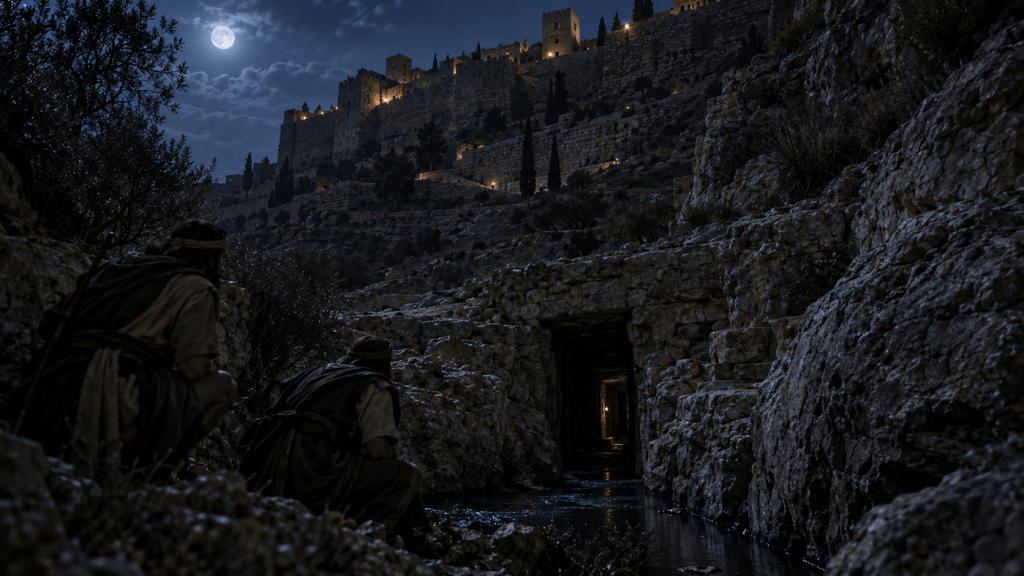
Artistic interpretation of how soldiers might have investigated the water approaches beneath Jebus. The biblical accounts do not describe the route.
Could Soldiers Have Entered from Below?
It is possible, but it cannot be proved.
Entering through a water system would have required more than finding an opening. David’s soldiers would have needed to understand the route, move through it without being detected, and find an exit that actually led inside the defenses.
That raises another question: How would they have learned about it?
Perhaps they watched people collecting water. Perhaps someone familiar with the system gave them information. Perhaps a resident betrayed the city. Perhaps Joab discovered a weak point while scouting the area.
Or perhaps the tsinnor was not an underground entrance at all.
The biblical accounts do not answer these questions.
That silence is frustrating for the historian—and irresistible for the storyteller.
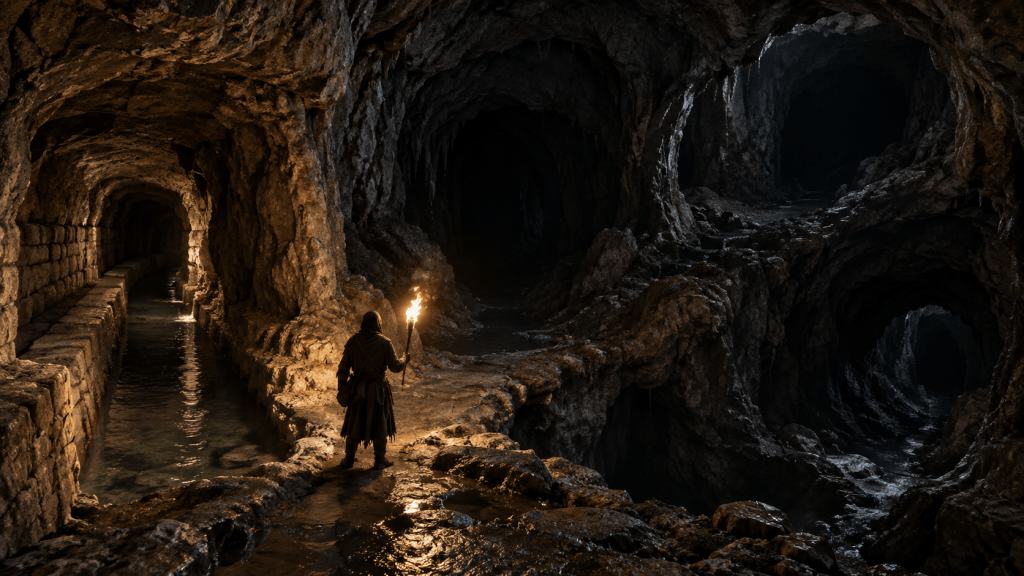
In Awaken The Dark, the known geography beneath Jebus becomes the entrance to something deeper.
Where the Known Passages End
When I created the underground Jebus of Awaken The Dark, I started with what is real: the steep ridge, the Gihon Spring, the need to protect the city’s water, and the ancient passages beneath Jerusalem.
Then I followed the unanswered questions.
What might lie beyond the excavated routes? Could forgotten passages survive beneath a city that has been built and rebuilt for thousands of years? What would those underground places mean to the people living above them—not only as sources of water, but as places of memory, danger, and fear?
The underground world in the novel is my imagined answer to those questions. Its hidden chambers and deeper passages belong to the story, not to the archaeological record. But the uncertainty that inspired them is real.
Beneath Jerusalem lies a landscape altered by Canaanites, Judahites, engineers, kings, laborers, and generations whose names have disappeared. Some passages carried water. Others protected it. Some were abandoned, blocked, rediscovered, or changed by those who came later.
And somewhere between the words of 2 Samuel and the stones beneath the city remains the mystery of the tsinnor.
David captured the fortress. Joab led the attack. Jebus became the City of David and, eventually, Jerusalem.
But the path by which the conquerors entered is still waiting in the dark.
Sources and Further Reading:
- 2 Samuel 5 and 1 Chronicles 11
- Ronny Reich and Eli Shukron, “The History of the Gihon Spring in Jerusalem,” Levant 36 (2004)
- Johanna Regev, Joe Uziel, Nahshon Szanton, and Elisabetta Boaretto, “Absolute Dating of the Gihon Spring Fortifications, Jerusalem,” Radiocarbon 59 (2017)
- Ronny Reich, “The Date of the Gihon Spring Tower in Jerusalem,” Tel Aviv 45 (2018)
- Israel Antiquities Authority, “Jerusalem: Water Systems of Biblical Times”
History leaves the route into Jebus unresolved. Awaken The Dark follows one path into the silence beneath the city.


Leave a Reply