
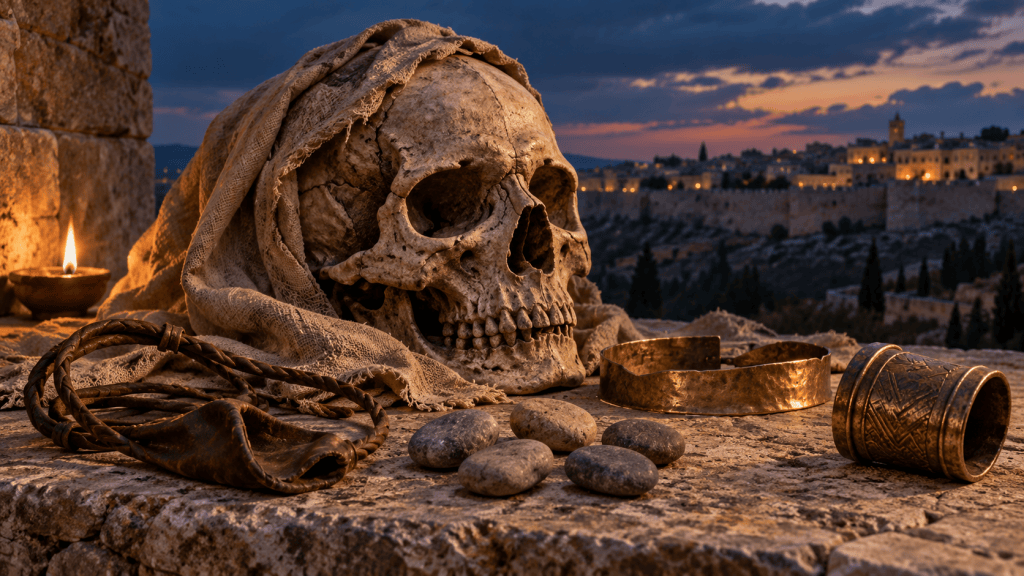
First Samuel says David carried Goliath’s head to Jerusalem before he controlled the city. What if the verse is telling us where the trophy ended up years later?
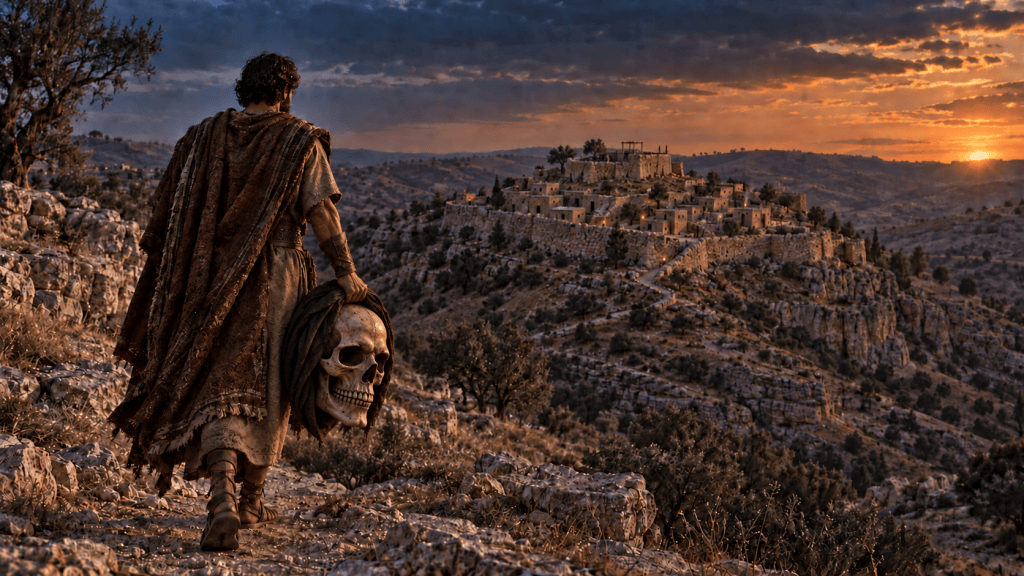
Goliath was dead, and David stood before King Saul holding the Philistine’s head.
It is one of the harshest images in the story. A young shepherd had walked into the Valley of Elah with a sling and five stones. He walked out carrying the head of the warrior who had terrified Israel’s army for forty days.
Then the Bible gives us a sentence that creates a problem.
David took the Philistine’s head and brought it to Jerusalem; he put the Philistine’s weapons in his own tent.
1 Samuel 17:54
Jerusalem did not belong to David.
The Jebusites still controlled the fortified city. David would not capture their stronghold until after Saul was dead, after David had become king, and after he had ruled from Hebron for seven and a half years. So how could he have brought Goliath’s head to Jerusalem on the day of the battle?
Perhaps he did not.
A Verse That Looks Ahead
The first clue is found only three verses later. First Samuel 17:54 tells us that David brought the head to Jerusalem. Then the story returns to Saul’s camp, where Abner brings David before the king.
Then Abner took him and brought him before Saul, with David still holding the Philistine’s head.
1 Samuel 17:57
The head has supposedly gone to Jerusalem, yet David is still holding it. That tells us the writer is not giving every event in a simple, moment-by-moment order. Verse 54 may be stepping outside the scene to tell us where the head eventually ended up. Verse 57 then returns us to what happened immediately after the battle.
Read that way, the verse does not require David to visit Jerusalem while Saul was still king. It may be giving us the final destination of the trophy years before the story reaches that point.
What Happened to the Head?
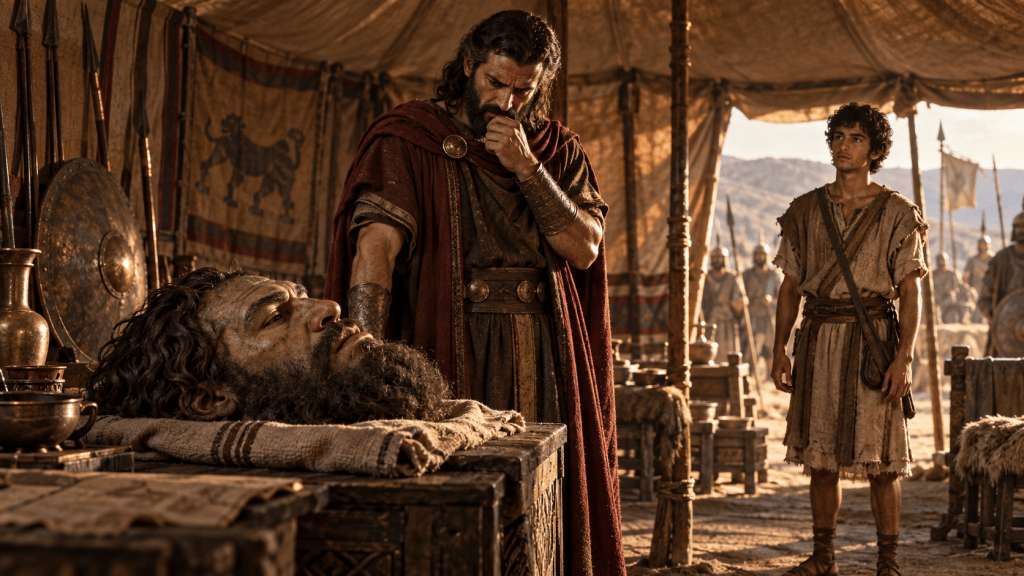
The Bible tells us that David carried Goliath’s head into Saul’s presence. It does not tell us what happened when he left.
Did David keep it? Did Saul claim it as a trophy of Israel’s victory? Was it displayed somewhere in the royal camp or stored with the weapons taken from Goliath? The text leaves that part of the story open.
Saul keeping the head would make sense. Goliath had challenged the whole army of Israel. His defeat was David’s victory, but it was also a national victory won under Saul’s reign. The king could have treated the remains of the Philistine champion as a royal trophy.
The biblical accounts of Saul’s own death show how enemy remains and armor were used in exactly that way. After the battle on Mount Gilboa, the Philistines cut off Saul’s head, stripped away his armor, and displayed the trophies in their temples. First Chronicles says Saul’s head was hung in the temple of Dagon. The treatment was meant to humiliate Israel and proclaim that the Philistine gods had won.
If Saul kept Goliath’s head, it would have carried the opposite message. Israel’s God had delivered the Philistine champion into the hands of a shepherd.
Years passed. Flesh would have given way to bone. The head David carried from the valley would eventually have become a skull. And while David fled through the wilderness, served among the Philistines, and waited for Saul’s reign to end, the trophy may have remained with the king.
The Messenger From Mount Gilboa
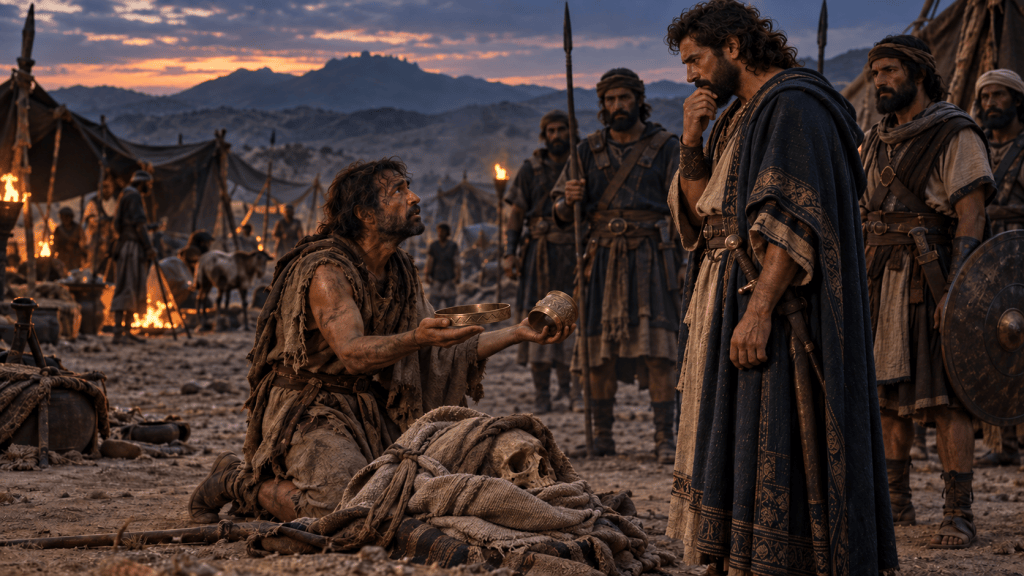
After Saul died, an Amalekite arrived at David’s camp in Ziklag with torn clothes and dust on his head. He announced that Saul and Jonathan were dead. Then he claimed that he had found Saul alive but dying on Mount Gilboa.
According to the man’s story, Saul asked him to finish what the battle had begun. The Amalekite said he killed Saul, removed the crown from his head and the band from his arm, and carried both objects to David.
His account does not match the end of First Samuel, where Saul falls on his own sword and dies before the Philistines find him the following day. The messenger may have discovered Saul’s body, taken the royal objects, and invented a story he thought David wanted to hear. Perhaps he expected a reward for removing David’s enemy and delivering the symbols of kingship.
He badly misunderstood David.
Why weren’t you afraid to lift your hand to destroy the Lord’s anointed?
2 Samuel 1:14
David ordered one of his men to strike the Amalekite down. The messenger had brought a crown, an armlet, and a claim that condemned him by his own words.
But could he have brought something else from Gilboa? If Saul had kept Goliath’s skull as a trophy, the Amalekite provides a possible way for it to return to David. Scripture names the crown and armlet because they established Saul’s identity and kingship. It does not say they were the only objects carried from the mountain.
This is a reconstruction, not a fact stated in the Bible. Still, it closes an important gap. The trophy passes from David to Saul after the victory in the Valley of Elah. It remains with Saul during his reign. After Saul’s death, the messenger from Gilboa unknowingly returns it to the man who first took it from Goliath.
David would then be holding the same terrible evidence of victory that he had carried into Saul’s presence years earlier. This time Saul was gone, Jonathan was dead, and the crown of Israel lay at David’s feet.
Seven Years Before Jerusalem
That is the point when the statement in First Samuel 17:54 may finally have been fulfilled.
David had first carried Goliath’s freshly severed head into Saul’s camp. Many years later, after Saul’s death and the conquest of Jerusalem, he could have carried the remaining skull into his new capital. The Bible describes both moments with one short sentence because its concern is the trophy’s destination, not the years it took to arrive there.
The Place of the Skull
That still leaves one question. Where in Jerusalem did David put it?
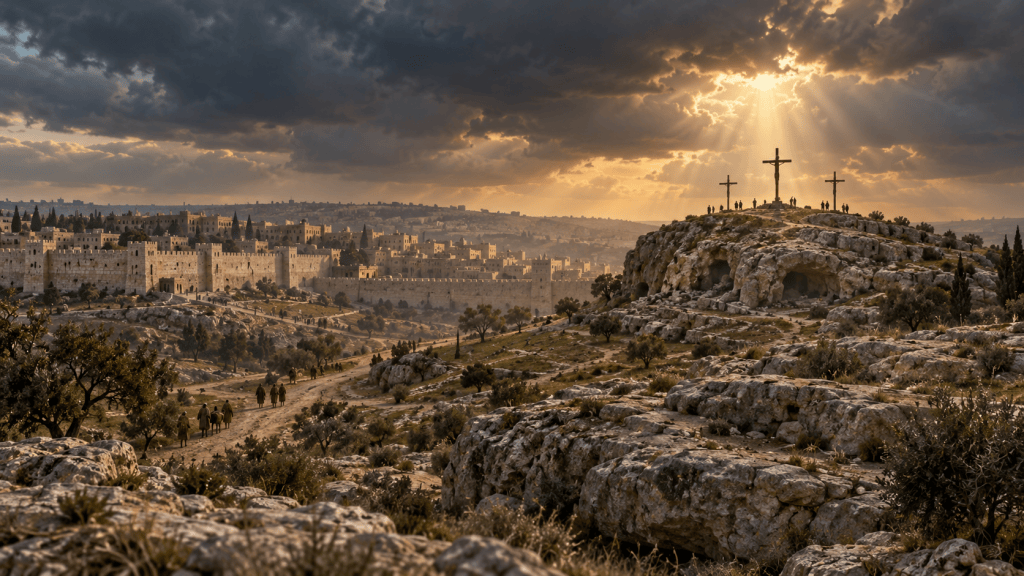
More than a thousand years later, Jesus Christ was taken outside Jerusalem to a place called Golgotha. The Gospel writers translate that name as the Place of the Skull. John says the location was near the city, close enough for many people to read the notice Pilate placed above the cross.
The Gospels never explain whose skull, if anyone’s, gave the place its name. It may have referred to the shape of the ground. It may have been connected with executions, burials, or some local memory already ancient by the first century. Scripture does not tell us.
Could Goliath’s skull have been placed there after David captured Jerusalem? It is possible to ask the question, but it cannot be proved. There is no biblical or archaeological evidence identifying Goliath’s remains at Golgotha. The similar sound of Goliath and Golgotha does not connect the words either. Golgotha comes from a word meaning skull; Goliath is the Philistine’s personal name.
The geography, however, leaves room for the possibility. The Jerusalem of David’s day occupied a much smaller area than the Jerusalem known by Jesus. A site lying outside the first-century city walls would have stood even farther outside the old Jebusite stronghold. David could have placed the skull near Jerusalem without putting it inside the palace or fortress itself.
Perhaps it marked the road into the city. Perhaps it served as a memorial to Israel’s deliverance or as a warning to anyone who threatened David’s new capital. Or perhaps the skull was placed somewhere else and the name Golgotha came from an entirely different story.
We should not turn a possibility into a claim. But we should not be afraid to notice the question.
What We Know and What We Imagine
The Bible tells us that David killed Goliath, removed his head, carried it before Saul, and eventually brought it to Jerusalem. It tells us that Saul died on Mount Gilboa, that an Amalekite brought David Saul’s crown and armlet, and that David captured Jerusalem years later.
It does not tell us that Saul kept Goliath’s head. It does not say the Amalekite carried the skull to David. It does not identify Golgotha as the skull’s final resting place.
Those are possibilities built inside the spaces the text leaves open. They should be presented that way. Yet together they offer a reasonable answer to the original problem. David did not have to carry the head into a Jebusite city he did not control. First Samuel may be looking years ahead, telling us what David eventually did with the trophy after Jerusalem became his
From the Shadows
Unanswered moments like this are where historical fiction begins.
While writing Awaken The Dark, I kept returning to the objects people carry away from moments of violence. A weapon, a stone, a piece of armor, or the remains of a defeated enemy can become more than a trophy. It can carry memory. It can feed pride. It can become a reminder of something a person fears or something he refuses to release.
I imagined that Goliath’s head did not simply disappear after David stood before Saul. Its story continued through the darkest years of Saul’s reign and eventually found its way back to David. The full path belongs to the world of the novel, but the question begins with the biblical text itself.
First Samuel tells us that the head reached Jerusalem. It simply does not tell us when.
A Victory Over Death
David’s victory over Goliath began his rise from an unknown shepherd to Israel’s most celebrated warrior. If the skull was carried to Jerusalem after the city became David’s capital, it would have stood as a reminder of the victory that first placed his name in the mouths of the people.
If it was taken to the place later called Golgotha, the meaning became greater than David could have known.
Goliath’s skull represented the defeat of one enemy through death. At the Place of the Skull more than a thousand years later, Jesus Christ was crucified. Christians, such as myself, believe that through his death and resurrection, death itself was defeated.
We cannot prove that the two events touched the same ground. We can only follow the trail left by one strange verse, from the Valley of Elah to Saul’s court, from Mount Gilboa to Hebron, and finally to Jerusalem.
The giant fell in a valley. His skull may have waited years for the city where its journey would end.
Sources and Scripture
- 1 Samuel 17:40–58 — https://www.biblegateway.com/passage/?search=1%20Samuel%2017%3A40-58&version=NIV
- 1 Samuel 31 — https://www.biblegateway.com/passage/?search=1%20Samuel%2031&version=NIV
- 2 Samuel 1:1–16 — https://www.biblegateway.com/passage/?search=2%20Samuel%201%3A1-16&version=NIV
- 2 Samuel 2:1–11 — https://www.biblegateway.com/passage/?search=2%20Samuel%202%3A1-11&version=NIV
- 2 Samuel 5:1–9 — https://www.biblegateway.com/passage/?search=2%20Samuel%205%3A1-9&version=NIV
- 1 Chronicles 10:8–12 — https://www.biblegateway.com/passage/?search=1%20Chronicles%2010%3A8-12&version=NIV
- John 19:17–20 — https://www.biblegateway.com/passage/?search=John%2019%3A17-20&version=NIV
- Hebrews 13:12 — https://www.biblegateway.com/passage/?search=Hebrews%2013%3A12&version=NIV


Leave a Reply